
What drives tissue machinery costs in a buyer's guide?
What Drives Tissue Machinery Costs in a Buyer’s Guide?
For procurement teams, a tissue machinery buyer guide cost analysis must go beyond the initial quotation. Equipment configuration, production speed, automation level, energy efficiency, raw-material compatibility, and after-sales support all shape total ownership costs and long-term return on investment. The difficult part is that two suppliers can quote systems with similar headline capacity while offering very different operating realities.
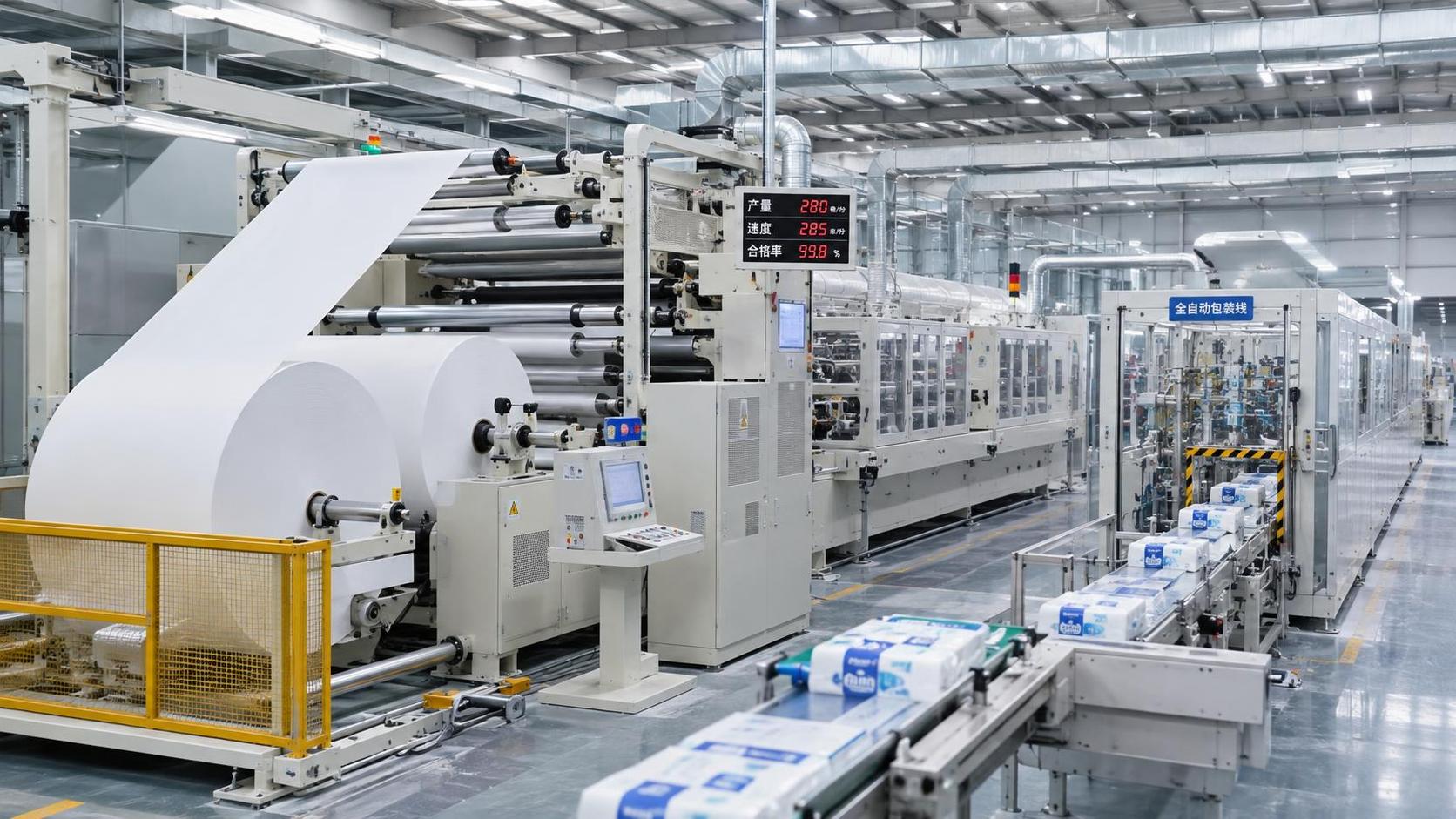
A tissue line is not one machine in isolation. Depending on the product, it may include rewinding or folding equipment, embossing units, perforation, tail sealing, log saws, roll or tissue packing systems, conveying, dust collection, and inspection devices. The cost question is therefore not simply “What does the machine cost?” It is “What level of output, hygiene control, labor input, material yield, and service risk does this configuration buy?”
This distinction matters in a category built around everyday, high-volume products. Toilet rolls, kitchen towels, facial tissues, hand towels, and napkins may appear straightforward, but their converting economics are sensitive to speed stability, web handling, embossing consistency, cut quality, packaging accuracy, and downtime. A lower purchase price can become expensive if it creates persistent waste, weak finished-product presentation, or dependence on hard-to-source parts.
Start with the production scope, not the equipment name
The first cost driver is the actual job the line must perform. “Tissue machinery” covers a broad range of converting systems. A buyer producing conventional toilet rolls has a different requirement from a business supplying boxed facial tissues, folded hand towels, jumbo rolls, or premium embossed household products. A quotation cannot be compared fairly until the intended product mix is clear.
Product format changes the required modules and the acceptable tolerance for variation. For example, a line designed for one stable roll diameter and one paper grade can be simpler than a line expected to handle multiple parent-roll widths, basis weights, ply structures, embossing patterns, pack counts, and retail-ready packaging formats. Flexibility is valuable, but it is not free: it often requires wider adjustment ranges, recipes in the control system, more sophisticated web-guiding arrangements, interchangeable tooling, and longer commissioning work.
Procurement specifications should define the target product before requesting price. Useful details include parent-roll dimensions, paper grade range, ply count, finished sheet size, roll diameter, core size, embossing requirement, perforation pattern, package style, and expected production shifts. If these points are vague, suppliers may fill the gaps with different assumptions, creating quotations that look comparable but are not.
Capacity costs more than speed on a nameplate
Production speed is one of the most visible price drivers, yet it is often misunderstood. A stated maximum speed is not the same as sustained commercial output. The useful measure is the output achievable with the buyer’s actual tissue grades, finished formats, operator skill level, changeover frequency, and packaging requirements.
Higher-speed tissue machinery generally requires stronger frames, more precise motion control, better tension management, more capable drives, reliable cutting systems, and safer material transfer between modules. At higher speeds, small variations in parent-roll condition or paper tension can turn into web breaks, poor perforation, uneven logs, or packaging interruptions. The mechanical and control architecture needed to manage these risks contributes materially to cost.
Buyers should ask suppliers to separate design speed, recommended operating speed, and expected output under the proposed configuration. It is also sensible to request clarity on what conditions the figures assume. Does output include planned stops for roll changes? Is it based on a particular roll diameter or package format? Does the downstream packer keep pace with the converting section? A fast rewinder followed by a constrained packaging cell does not create a fast line.
Automation changes the cost structure, rather than simply reducing labor
Automation is frequently presented as a direct labor-saving feature. That is only part of the picture. Automatic parent-roll handling, core feeding, tail sealing, log transfer, packing, pallet handling, recipe management, and inspection can reduce manual intervention, but their larger value may lie in repeatability, safety, cleaner material flow, and fewer disruptions during long runs.
The cost premium for automation depends on the point at which it is introduced. Adding an automated packaging system to a converting line can involve conveyors, buffering, synchronization controls, guarding, sensors, electrical integration, and layout changes. The equipment price may be only one component of the investment. Buyers should also account for floor space, access for maintenance, compressed air, electrical load, and whether the plant’s material flow can support automatic operation without creating bottlenecks upstream or downstream.
Not every plant needs the highest automation level on day one. A practical procurement decision may be to specify an automation-ready layout: control capacity, conveyor interfaces, reserved space, and compatible communication architecture can make later expansion less disruptive. The key is to distinguish a genuine upgrade path from a vague promise that automation “can be added later.”
Web handling, embossing, and converting quality are not cosmetic details
In tissue converting, the quality of web tension control influences production economics from the first unwind to the final pack. Poor tension stability can contribute to wrinkling, breaks, misaligned embossing, uneven perforation, or variable finished-roll density. These effects may be intermittent, which makes them particularly costly: they consume operator attention, create uncertain quality losses, and can be difficult to isolate after installation.
Embossing adds another layer of cost and decision-making. A basic configuration may meet functional requirements, while premium products may need more elaborate embossing, lamination, printing, or decorative effects. The buyer should not evaluate this only as a visual feature. Embossing affects bulk, hand feel, ply bonding, material behavior, and perceived product quality. It also introduces roll selection, pressure setting, pattern maintenance, and cleaning considerations.
Likewise, cutting and perforation systems should be assessed through the finished product, not only through machine descriptions. Ask how the proposed setup manages blade changes, dust, cut consistency, core positioning, and the range of product diameters. A system that performs well on a supplier demonstration material may require adjustment when confronted with local paper grades or recycled-content variations.
Raw-material compatibility can quietly determine the real operating cost
Jumbo-roll tissue is normally the largest recurring cost in a converting operation, so machinery that only runs well on a narrow range of paper can limit purchasing flexibility. Fiber composition, softness, moisture, strength, caliper, parent-roll winding quality, and dust characteristics can all influence line behavior. A buyer sourcing from more than one mill should consider this before locking in a machine configuration.
This is especially relevant where procurement strategies include certified virgin fiber, recycled grades, locally available tissue, or imports from multiple suppliers. Requirements connected to FSC claims, EUDR-related supply-chain documentation, or customer sustainability policies are not simply paperwork questions; they can affect the paper grades a plant expects to buy. The machinery supplier should confirm what material range has been considered, while the buyer should verify applicable market and customer requirements independently.
A useful acceptance plan may include trial material representative of normal production rather than relying entirely on ideal samples. Where that is not possible before shipment, the contract should describe the paper assumptions used for performance acceptance. This reduces later disputes over whether a speed, waste, or quality issue is caused by the line, the material, or the operating conditions.
The quote must include the boundaries of supply
Many tissue machinery budget surprises arise outside the main machine quotation. Freight, customs handling, foundations, installation labor, electrical works, air supply, extraction, consumables, spare parts, training, commissioning, and local safety adaptations can materially change the project total. None of these items are unusual; the risk comes from leaving responsibility unclear.
The same discipline should apply to compliance. Electrical design, machine guarding, emergency-stop arrangements, documentation, and local conformity obligations should be reviewed against the destination market before purchase order release. It is safer to ask what is included, what standard the supplier designs to, and what the buyer must provide than to assume that a generic statement of compliance covers every local condition.
Energy, maintenance, and consumables belong in the investment model
Energy use deserves attention, but it should be evaluated in context. Drive efficiency, vacuum systems, compressed-air demand, heating where applicable, idle running, and production stability all influence utility cost. The most useful question is not whether a supplier labels a machine energy-efficient, but what installed loads, normal operating conditions, and energy-consuming auxiliaries are included in the proposal.
Maintenance cost is similarly shaped by design choices. Accessible components, standardized bearings and sensors, clear lubrication arrangements, diagnostic capability, and availability of drawings can have a greater long-term effect than a small difference in initial price. Buyers should request a recommended critical-spares list and separate consumables from capital spares. Blades, belts, seals, embossing components, adhesives where used, and packaging-machine wear parts should not be treated as an afterthought.
Remote diagnostics can be useful, but only if the plant has reliable connectivity, suitable cybersecurity rules, and named escalation contacts. For facilities far from the equipment supplier, local technical representation or a well-defined spare-parts logistics plan may be more meaningful than a general service statement.
How to compare bids without rewarding the incomplete one
A structured comparison sheet is often more valuable than another round of price negotiation. Normalize each quotation against the same product assumptions and list every included and excluded item. Then assess the proposals across four linked dimensions: delivered capability, operating cost exposure, implementation risk, and future adaptability.
For a credible tissue machinery buyer guide cost review, look for evidence rather than broad claims. Ask for layout drawings, utility schedules, module descriptions, control-system scope, tooling lists, maintenance recommendations, training plans, warranty terms, and acceptance conditions. Where a supplier offers a lower price, identify exactly which technical or commercial assumption is different. Sometimes the answer is sensible—perhaps the line is deliberately simpler because the product range is stable. Sometimes it reveals a hidden future purchase.
At IPPS, tissue processing is examined alongside digital printing, corrugation, and post-press automation because the same industrial questions recur across paper-based manufacturing: web control, yield, material variability, machine integration, and traceable operating assumptions. That wider viewpoint is useful when a tissue project includes retail packaging, changing sustainability expectations, or the need to connect converting output with downstream logistics.
A better buying decision is built around risk visibility
The cheapest tissue machine is not automatically the wrong choice, and the most automated system is not automatically the right one. The appropriate investment depends on product positioning, demand stability, labor conditions, local service access, available utilities, paper-sourcing strategy, and the plant’s ability to operate more complex equipment consistently.
Before final selection, procurement teams should convert the supplier quote into a project-level cost model: equipment price, auxiliary systems, site work, start-up resources, expected spare parts, operating utilities, and reasonable contingency for integration. Just as important, they should document the assumptions behind promised output and quality. When those assumptions are visible, comparing tissue machinery becomes less about negotiating a number and more about choosing a production system that can perform under real plant conditions.
Industry Briefing
Get the top 5 industry headlines delivered to your inbox every morning.
Recommended News