
What Causes Inconsistent Perforation in Tissue Converting?
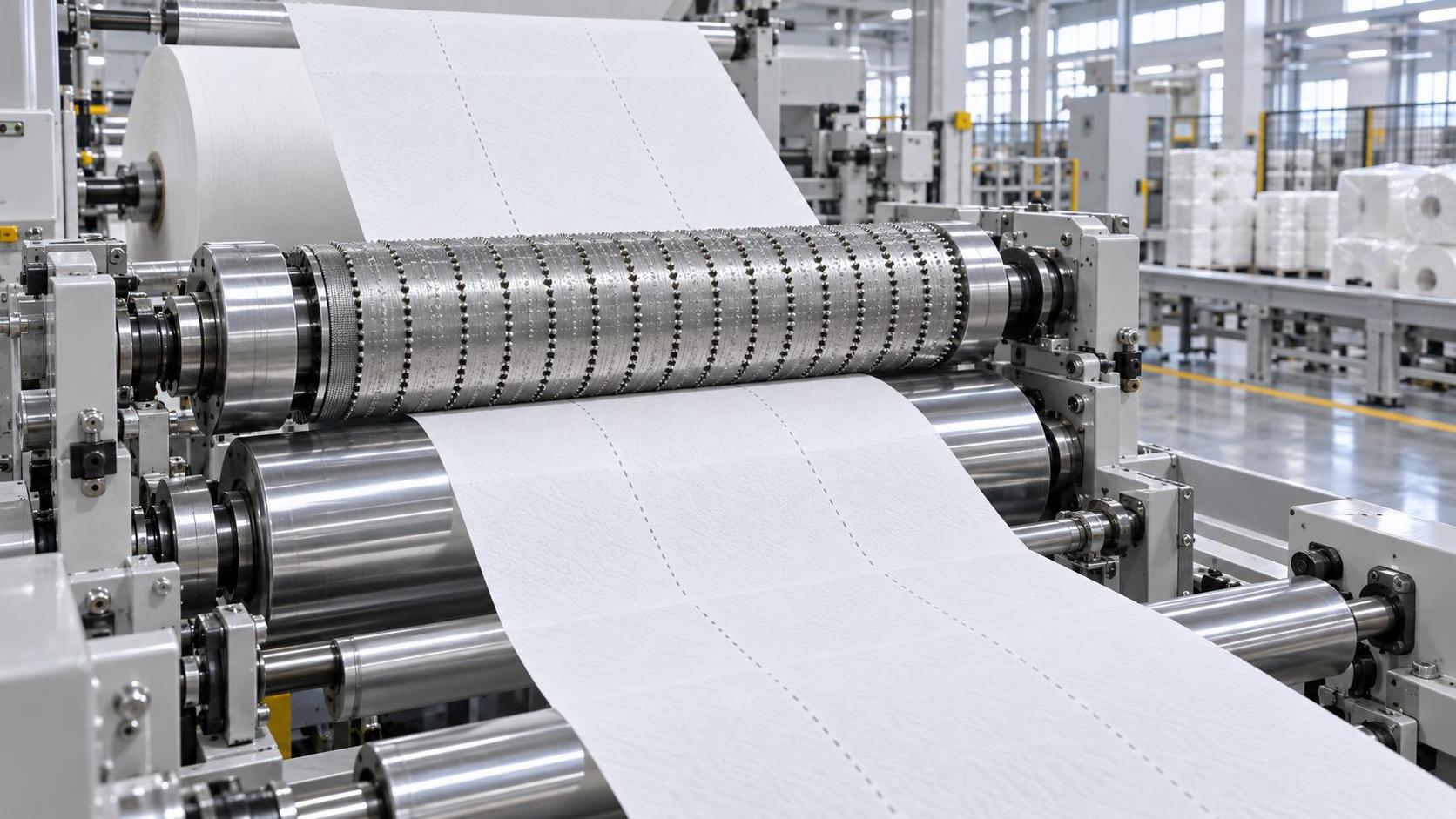
A tissue roll can look perfectly acceptable at the rewinder and still fail the moment it reaches a consumer. Sheets may tear too easily, refuse to separate cleanly, pull two or three sheets at once, or leave long uncut bridges along the perforation line. These are not minor cosmetic defects. In toilet tissue, kitchen towels, and folded towel products, perforation directly affects perceived quality, pack integrity, converting waste, and line efficiency.
So, what causes inconsistent perforation in tissue converting? Usually, it is not one dramatic machine failure. More often, it is a small mismatch between web tension, blade condition, anvil condition, timing, tissue structure, and speed. At lower speeds, the process may appear stable. Once production accelerates, those small deviations become visible as uneven sheet separation and variable roll performance.
The most useful way to troubleshoot the problem is to stop treating perforation as an isolated cutting event. It is the result of a moving web being controlled, supported, weakened, and rewound in a very short process window. A change upstream in embossing, lamination, parent-roll quality, or tension control can show up downstream as a perforation complaint.
Perforation is a controlled weakness, not simply a cut
A good tissue perforation must satisfy two opposing requirements. It needs enough remaining fiber bridges to keep the web intact through rewinding, log handling, cutting, packaging, transport, and dispensing. At the same time, it must separate with a predictable pull force in the user’s hands. If the cut is too deep, rolls can break during production or unwind prematurely. If it is too shallow, the consumer must tug hard, and the sheet tears outside the intended line.
That balance is particularly sensitive in lightweight, highly creped, embossed, or multi-ply tissue. The same perforation setting that works on a stronger, denser base sheet may be excessive on a softer grade. A converting team should therefore avoid assuming that a nominal blade setting can be carried unchanged from one SKU to another. Basis weight, ply count, embossing depth, lotion application, fiber blend, moisture condition, and finished roll density all influence how the web responds.
In practical terms, an “inconsistent” perforation can mean different things: variation across the web width, variation from roll to roll, cyclic defects at a fixed machine interval, or gradual deterioration over a shift. Each pattern points toward a different likely cause.
Unstable web tension is often the first place to look
Tissue is forgiving in some operations and surprisingly unforgiving in others. Before the perforation point, a web that is alternately slack and over-tensioned does not meet the blade in the same condition each time. When tension rises, the sheet can be pulled more tightly against the perforation element, increasing cut penetration or creating a cleaner break than intended. When tension falls, the web may flutter, shift, or fail to seat consistently against the anvil.
This is why operators sometimes see a strange combination: perforations that are too weak on one side of a log and too strong on the other, even though the blade appears correctly adjusted. The root cause may be tension profile rather than blade depth.
Common tension-related sources include parent-roll diameter changes that are not being compensated smoothly, brake response delays, dancer-roll instability, contaminated rollers, slipping drive surfaces, and poor speed coordination between the unwinder, embossing section, perforator, and rewinder. Splices deserve attention as well. A splice can temporarily alter caliper and tension behavior, then trigger a short run of poor perforation that may not be noticed until finished-roll inspection.
Rather than watching only one tension value on the HMI, review the trend around the defect. A stable average can conceal rapid fluctuations. In tissue converting, the variation often matters more than the displayed setpoint.
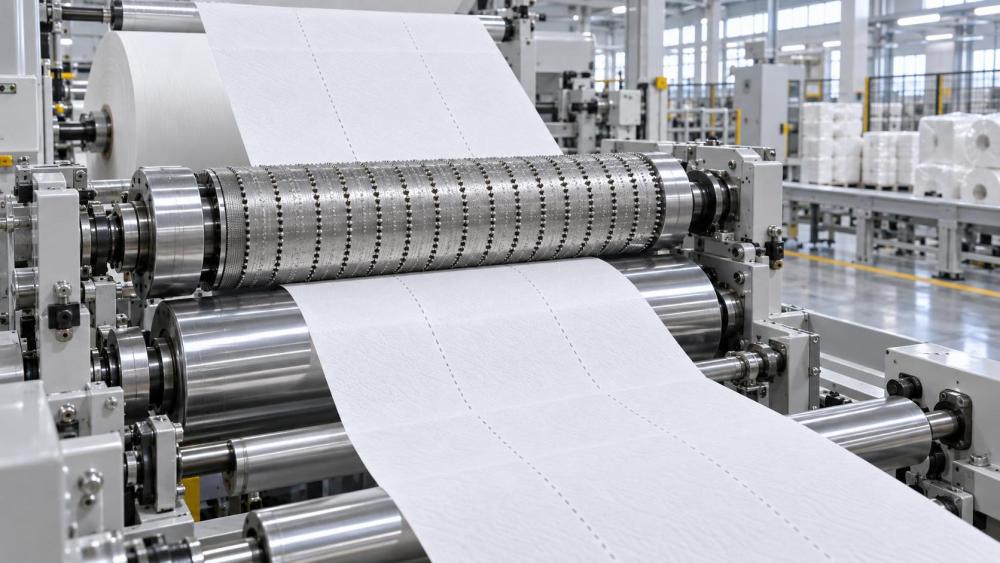
Blade wear, damage, and anvil condition change the cut long before a blade “fails”
Perforation blades are consumable precision parts. Their condition does not move from good to unusable in one step. Edges gradually round off, teeth pick up adhesive or fiber deposits, and local damage can create a repeating weak or strong section. On a multi-ply product, a blade may still perforate the outer ply reasonably well while producing poor penetration in the inner ply. The roll then feels inconsistent when torn, even though a quick visual check of the line appears acceptable.
The matching anvil or counter surface is equally important. Grooving, uneven wear, hard spots, misalignment, or contamination changes how the blade enters the tissue. It is a common mistake to replace a blade without inspecting the complete cutting interface. If the anvil has a worn track, the new blade may inherit the same quality problem immediately.
A useful diagnostic clue is defect periodicity. If an irregular perforation repeats at the same interval, inspect rotating elements for a damaged tooth, debris buildup, eccentricity, or localized anvil wear. If the defect gradually worsens across the shift, blade contamination, heat, dust accumulation, or material drift is more likely.
Cleaning must be controlled rather than improvised. Abrasive cleaning methods can alter blade geometry or damage protective surfaces. The correct approach depends on the machine design, blade material, and contaminant involved, so maintenance instructions from the equipment supplier should take priority.
Timing errors are easy to miss, especially after speed changes
In high-speed rewinders, the perforation action must remain synchronized with web travel and the machine’s broader motion profile. A timing offset can affect sheet length, cut consistency, and the location of the perforation relative to embossing or printed registration marks. Sometimes the obvious symptom is an incorrect sheet count per roll. In other cases, the sheet length appears close enough, but separation force varies because the web is being contacted at a slightly different point in the cycle.
Mechanical backlash, encoder issues, loose couplings, servo tuning drift, and software parameter changes can all contribute. Timing problems frequently emerge after a maintenance intervention, a controller replacement, a recipe change, or an aggressive speed ramp. If poor perforation begins immediately after one of these events, do not start by adjusting blade pressure. Confirm synchronization first.
A sound test is to compare performance at several controlled speeds. If perforation is acceptable at a moderate speed but becomes erratic at higher speed, the problem is more likely related to dynamic control, tension response, vibration, or timing than to the static blade setting alone.
Tissue quality and roll hardness can make a stable machine look unstable
Not every perforation defect originates in the converting line. Parent rolls can vary in moisture, caliper, crepe structure, tensile profile, winding density, and edge condition. When those differences are significant, the same machine recipe may generate different cut behavior from one parent roll to the next.
Moisture is especially worth monitoring because it can alter tissue softness and tensile response. Environmental swings in the converting hall may also affect exposed webs. The point is not that every quality issue is a moisture issue; it is that tissue is a fibrous material, and its response changes with condition. Process teams should connect parent-roll inspection records with finished-roll complaints instead of treating raw-material checks and perforation checks as separate routines.
Finished-log hardness adds another layer. Excessive winding tension or an unsuitable hardness profile can make a perforation behave differently when the consumer pulls the sheet. A very tight roll may resist separation even when the cut pattern looks correct. A loose roll may telescope, deform, or break prematurely. The best perforation setting is therefore not simply the one that looks clean during production; it is the one that performs correctly after winding, cutting, packing, and normal handling.
Dust, adhesive, embossing effects, and vibration create the “small” defects that become expensive
Tissue converting generates lint and fine dust. Over time, deposits can collect on sensors, rollers, blades, anvils, vacuum systems, and web-guiding components. A slight buildup may not stop the machine, but it can alter traction, sensor reliability, or blade contact. In operations producing embossed and laminated tissue, adhesive transfer or uneven bonding can further complicate the picture. A perforation line crossing an area with uneven ply bonding will not tear like a line crossing a uniformly bonded area.
Vibration is another understated cause. Loose fasteners, worn bearings, unbalanced rotating parts, or a deteriorating drive component can introduce periodic variation. The faster the line runs, the more clearly the defect may appear. Operators often compensate by increasing pressure, which can temporarily mask the issue while accelerating blade and anvil wear.
That is a costly trade-off. More pressure is not a universal cure. It may produce cleaner cuts for a short time, but it can also increase dust, weaken bridges too much, and shorten component life.
A practical troubleshooting sequence
When inconsistent perforation appears, isolate the pattern before changing settings. Pull samples from across the web width, from the beginning and end of the parent roll, and at different machine speeds. Record whether the defect is random, side-specific, cyclic, or linked to a particular roll or shift. This basic discipline prevents the familiar problem of changing five variables and learning nothing.
- Check web tension trends and web tracking before adjusting the perforator.
- Inspect blade teeth, blade mounting, anvil surface, and cutting alignment under proper lockout procedures.
- Verify encoder feedback, servo synchronization, sheet-length settings, and any recent recipe or maintenance changes.
- Compare parent-roll properties and finished-log hardness against lots that converted normally.
- Clean lint-sensitive areas and investigate repeating defects for vibration, runout, or contamination.
- Validate changes with actual tear tests after rewinding and packaging, not only with an in-process visual check.
The final point matters. A tissue converter may be tempted to judge quality from a single hand tear at the machine. That is useful, but insufficient. Separation should be assessed in a way that reflects the intended product: toilet roll, towel roll, folded tissue, or a premium multi-ply format may each have different expectations for pull, break location, and sheet presentation.
Consistency comes from connected process control
Modern tissue machinery increasingly links unwinding, embossing, perforation, rewinding, and automatic packaging through shared control data. That direction is valuable because it makes hidden correlations easier to see: a tension disturbance, for example, can be compared with perforation complaints, roll hardness, and downstream rejects. But data does not replace basic mechanical discipline. A clean blade, sound anvil, stable web path, and verified timing remain fundamental.
For converters evaluating process improvements, the priority should be repeatability rather than chasing the highest possible line speed. The most productive line is not the one that briefly reaches maximum output; it is the one that holds its perforation specification without creating rework, customer complaints, or frequent adjustment stops. In tissue converting, a clean tear is often the visible proof that the entire web-handling process is under control.
Industry Briefing
Get the top 5 industry headlines delivered to your inbox every morning.
Recommended News