
Which corrugated converting solutions suit e-commerce packaging?
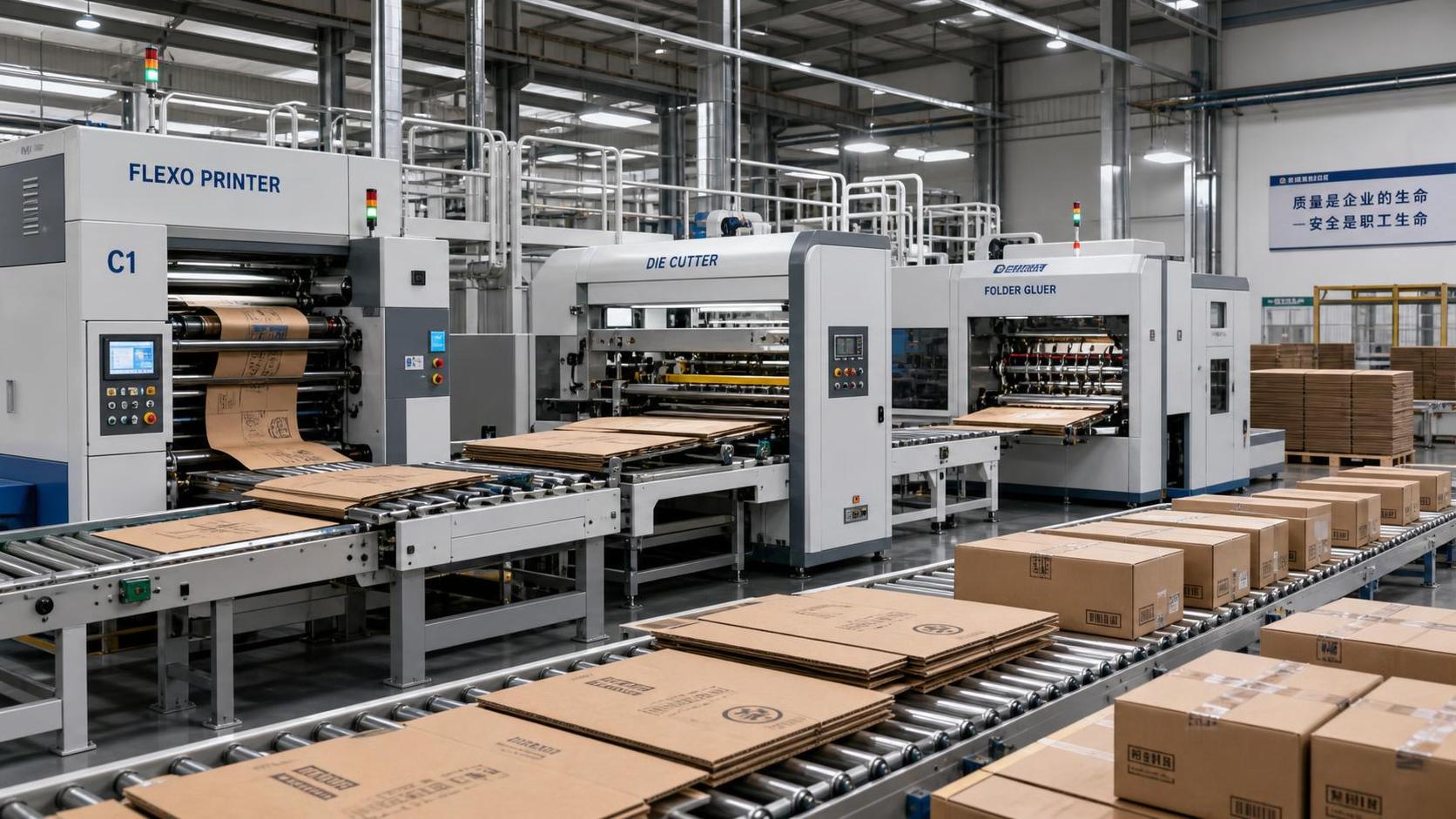
E-commerce packaging is best served by a converting configuration built around the parcel mix, board grade range, graphic requirements, and frequency of changeovers. A high-volume operation shipping a narrow family of regular slotted cartons needs a different line from one handling variable-size direct-to-consumer packs, retail-ready mailers, and short promotional runs. The right answer is rarely a single machine category. It is a coordinated path from board preparation through printing, cutting, creasing, folding, and adhesive application, with each stage matched to the next stage's tolerances.
Start with the pack rather than the machine speed printed on a specification sheet. Record the smallest and largest blank, flute profiles, liner combinations, typical order quantity, number of SKU changes per shift, required print coverage, closure style, and whether the pack is erected automatically or manually. These conditions determine whether a simple flexographic converting line, a rotary die-cutting line, a flatbed die-cutter, digital print integration, or a modular mixed workflow is the more suitable choice.
Match the converting route to the carton family
Regular slotted cartons remain efficient for many parcel applications because their geometry is stable, tooling is straightforward, and board utilization is often favorable. Where the business mostly runs repeat designs in medium or long batches, flexographic print combined with rotary die-cutting and folder-gluing can provide a continuous workflow. Rotary tools are particularly effective when the carton design has uncomplicated cuts, consistent score patterns, and a blank format that remains within a narrow range.
Mailer boxes, self-locking packs, tear-strip formats, returnable structures, and presentation-oriented e-commerce cartons create different demands. They often include multiple panels, internal retention features, perforations, tightly controlled creases, or cutouts that must remain clean after folding. Flatbed die-cutting is usually the stronger option where design complexity or crease quality matters more than uninterrupted rotary speed. The platen action gives more controlled pressure across detailed tooling and accommodates designs that would be difficult to hold accurately on a rotary cylinder.
A mixed portfolio often justifies separating simple transport cartons from value-added mailers. Routing every design through one highly flexible machine can create unnecessary setup loss, while assigning all work to a fast dedicated line can force awkward compromises in carton design. A practical arrangement reserves continuous rotary converting for predictable repeat work and uses flatbed or digitally supported production for variable, intricate, or short-run packaging.
Board behavior sets the real operating window
Corrugated converting performance begins before the blank reaches the die. Flute type, liner stiffness, moisture condition, adhesive bond quality, and warp direction all influence print appearance, score quality, cut cleanliness, and glue performance. A line that runs smoothly on flat, dry single-wall board may show registration drift, cracked liners, or uneven fold geometry when it receives warped board or a heavier double-wall structure.
Do not judge board only by caliper and nominal basis weight. Two boards with similar thickness can react differently under compression because flute formation, liner tensile behavior, and residual moisture are different. E-commerce packs are commonly exposed to parcel handling loads, so the converting process must preserve the board's structural contribution. Excessive crush at the print nip, die station, or crease rule reduces flute integrity and can weaken compression performance even when the carton looks acceptable at the delivery table.
Creasing needs especially careful evaluation. A crease that folds easily on a sample may split the outer liner after storage in a dry environment, or it may spring back when board moisture rises. Score width, rule height, counter material, board direction, and fold sequence interact. The most reliable assessment uses production-grade board, actual print coverage, and the intended fold orientation. A hand-folded sample alone does not reveal whether a high-speed folder-gluer will keep the panel square.
Printing choices should follow artwork volatility
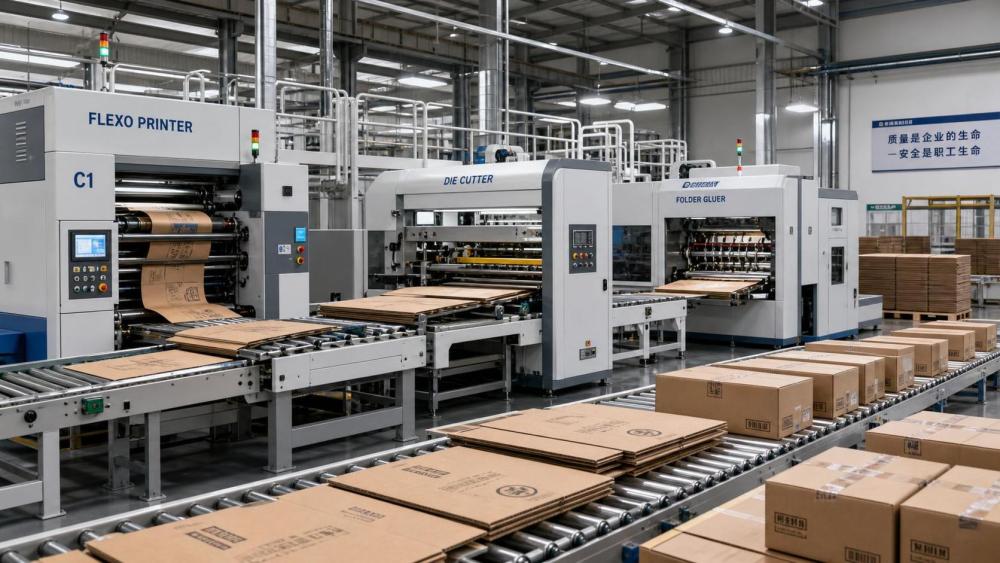
Flexographic printing remains well suited to repeat graphics, transport marks, simple branding, and designs where print plates are justified by run length. Its value lies in a stable, integrated process when artwork changes are limited. Selection should include an honest review of plate storage, plate mounting repeatability, ink management, anilox maintenance, and the time required to bring color and registration into tolerance after a job change.
Digital corrugated printing changes the equation when versioning, localized graphics, seasonal campaigns, or many low-volume SKUs are part of the work mix. It removes plate preparation but introduces other constraints: board surface variation, ink penetration, drying capacity, image-to-cut registration, and data preparation. A digital press can produce visually sharp graphics while the downstream die-cut process still creates an unacceptable result if the board shifts, the camera reference is inconsistent, or the cutting file does not reflect material expansion.
Full-coverage printing requires attention beyond color. Heavy ink coverage can alter surface friction and folding behavior. It can also affect the adhesion zone where cold glue is applied. Leave glue flaps free of unsuitable coatings, or validate the adhesive against the finished surface rather than against unprinted liner. When a carton uses an interior print, confirm that rub resistance and odor requirements align with the packed product and the final distribution environment.
Die-cutting accuracy is a system issue
Die-cutting specifications are often read as an isolated accuracy claim. In production, the usable tolerance depends on board dimensional stability, feeder alignment, print registration, die condition, stripping, waste evacuation, and folding tolerances. A precise die cannot correct a blank that enters skewed or varies in length due to moisture movement.
Rotary die-cutting favors speed and repeatability on less complex designs, but tool geometry, anvil condition, and cylinder pressure need continuous control. Overpressure may make cuts appear clean while crushing flutes or creating excessive dust. Underpressure leaves hanging chads, incomplete perforations, or uncut fibers that interfere with stripping and later folding. Tool wear often shows first in fine internal cuts, small tabs, and perforation bridges rather than in the outer carton profile.
Flatbed equipment deserves priority when the design includes detailed locking features, large windows, shaped edges, or demanding crease patterns. Its setup should be assessed through make-ready time as well as finished quality. Ask how quickly a die can be positioned, how waste stripping is handled, whether blank separation is reliable, and how the machine detects missed sheets or incomplete waste removal. A carton with a small retained waste piece can jam a folder-gluer several stations later, turning a die-cut issue into a line-stop issue.
Folder-gluer selection should be based on the finished carton
Folder-gluing is often treated as a final utility, yet it determines whether a converted blank becomes a square, erectable parcel pack. The feeder must handle the board range without marking printed surfaces or distorting thin microflute material. Folding rails, carriers, and compression sections need enough adjustment range for the smallest mailer and enough support for the largest blank. A machine that handles the nominal blank width may still struggle where narrow panels, reverse folds, or locking tabs require precise timing.
Glue selection is inseparable from machine choice. Cold adhesive systems are common for standard side seams, but adhesive open time, solids content, nozzle pattern, and board absorbency have to match line speed and compression distance. Too little compression leaves a weak bond; excessive pressure can squeeze adhesive beyond the flap edge and contaminate printed surfaces. Hot-melt systems can suit particular closures or difficult substrates, although the application temperature and cooled bond behavior must be validated against board coatings and pack storage conditions.
For e-commerce mailers with self-locking geometry, a gluing section may not be the primary forming method. The important question becomes whether creases, lock tabs, and delivery orientation allow the pack to be erected reliably at fulfillment. Folding a sample by hand can conceal a lock design that catches at speed or requires more force than an automated erecting station can apply.
Automation should remove unstable handoffs
Automation has the highest value where material handling creates variation between otherwise capable machines. Automatic blank feeding, print-to-cut registration control, board tracking, recipe recall, inline inspection, and powered delivery all reduce the chance that a minor alignment error becomes scrap. The goal is not to automate every movement. It is to stabilize the points where board orientation, job identity, or dimensional reference is lost.
Recipe management is useful only when stored settings represent verified production conditions. A job file should connect board grade, blank dimensions, print reference, die identification, score configuration, glue pattern, folding positions, and inspection limits. Loading generic speed and pressure values without material-specific adjustments can repeat the same defect efficiently. Revision control also matters when carton artwork or a structural file changes; the digital print file, die layout, and glue program must refer to the same approved version.
Inspection should focus on defects that affect parcel performance: missing glue, skewed seams, incomplete cuts, damaged perforations, unreadable codes, wrong blank orientation, and carton dimensions outside the erecting window. Surface defects that are visually obvious but functionally harmless should not be allowed to dominate the inspection strategy at the expense of seam and structure checks.
Evaluate capacity through changeover and recovery
Maximum mechanical speed is a weak comparison metric for e-commerce work with variable designs. Compare usable output across representative runs, including board loading, setup, print adjustment, tool changes, glue stabilization, quality release, waste handling, and recovery after a stoppage. A line with a lower headline speed can produce more accepted cartons when it reaches stable production quickly and retains settings accurately between jobs.
Maintenance access is equally relevant. Die stations need routine inspection of cutting rules, rubber, anvils, bearings, and pressure settings. Print sections require cleaning discipline that prevents dried ink or contamination from creating inconsistent coverage. Folder-gluer sections need accessible glue circuits, belts, carriers, and compression elements. Evaluate whether these tasks can be completed without lengthy realignment, because difficult maintenance commonly turns into deferred maintenance and then into repeat defects.
The most suitable corrugated converting solution is therefore defined by its behavior across the actual job mix: it must protect board strength, hold print and cut registration, create dependable folds and seams, and regain stable output after routine changes. When those conditions are demonstrated with representative materials and carton structures, the selected equipment is far more likely to support efficient e-commerce packaging than a line chosen solely for nominal speed.
Industry Briefing
Get the top 5 industry headlines delivered to your inbox every morning.
Recommended News