
What drives the price of corrugated converting solutions?
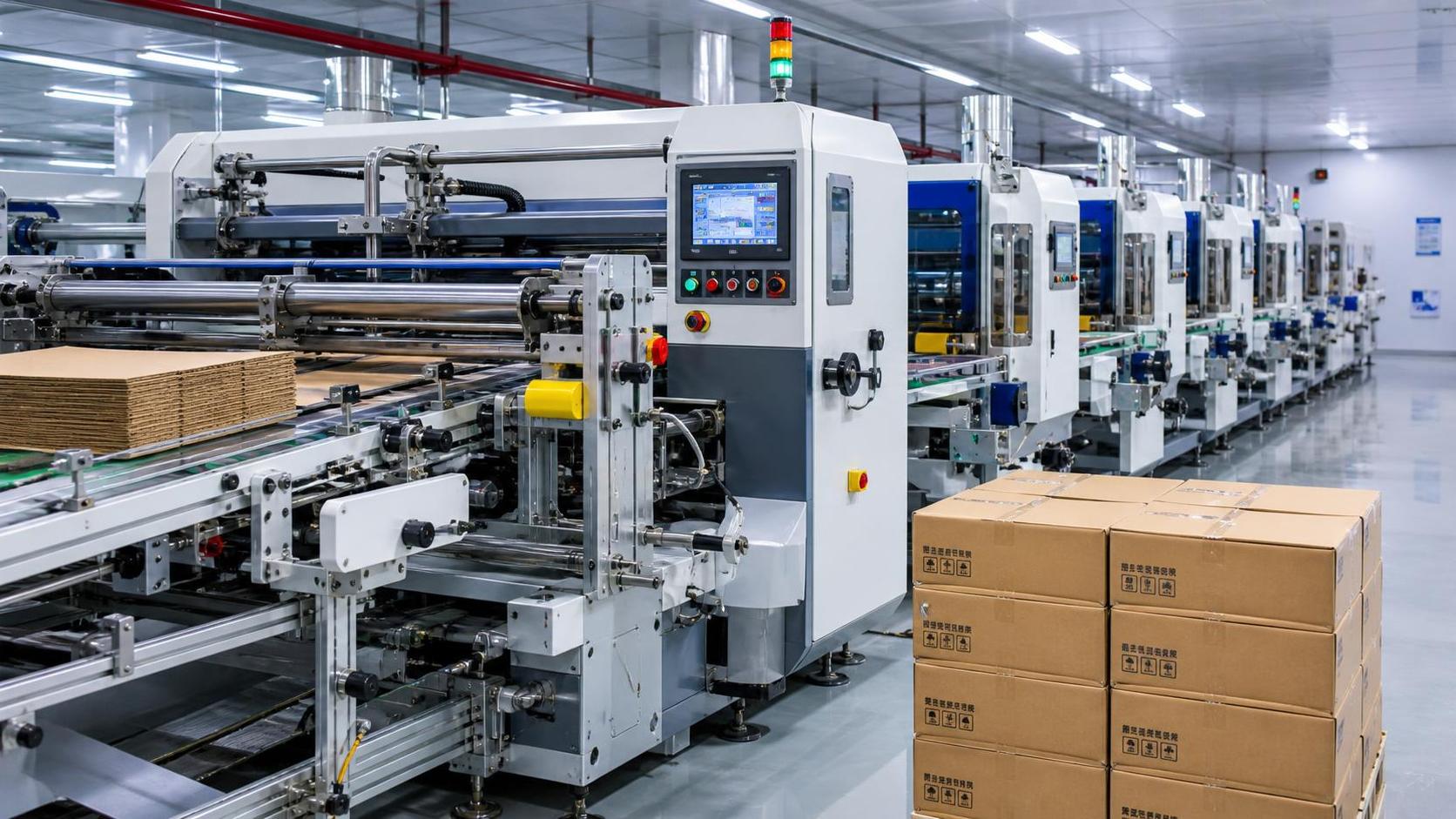
What Drives the Price of Corrugated Converting Solutions?
For a procurement team, the corrugated converting solutions price is rarely explained by the headline number on a supplier quotation. Two die-cutters, folder gluers, or digital corrugated printing lines may appear to serve the same job, yet their investment levels can be dramatically different once automation, usable throughput, tooling, integration, and support obligations are examined.
That is because “converting” is not one machine category. It can cover flexographic printing, rotary or flatbed die-cutting, creasing, stripping, folding, gluing, digital printing, inline inspection, pallet handling, and the controls that connect each stage. A low purchase price can be sensible for a stable, limited-format operation. It can also become expensive very quickly when the plant faces frequent job changes, demanding e-commerce box designs, labor shortages, or inconsistent board quality.
The practical question is not simply, “Which supplier is cheaper?” It is: “Which configuration produces acceptable boxes, at the required mix and volume, with a cost structure we can actually sustain?”
Machine scope changes the quote before performance is even discussed
One common purchasing mistake is comparing quotations that do not include the same production scope. A basic flexo folder gluer, for example, may print, slot, fold, and glue standard regular slotted cartons. Another line may add pre-feeders, servo-controlled setup, die-cutting capability, bundle counting, strapping interfaces, vision inspection, and automatic pallet transfer. Both may be described loosely as corrugated converting solutions, but they solve very different operational problems.
The same issue arises with die-cutting. Rotary die-cutting is often attractive for repeatable high-volume work, while flatbed equipment can be better suited to complex shapes, shorter runs, or heavier board grades. Neither route is universally “better.” The real cost driver is whether the machine architecture fits the box portfolio. Paying for a highly flexible platform is hard to justify if most orders are a narrow range of simple cases. On the other hand, buying a rigid, low-spec configuration for a fast-changing retail packaging mix can lock a plant into excessive setup losses.
Procurement should therefore request a clear scope map with every offer. It should identify what happens from blank feeding to finished bundle, what remains manual, which conveyors and auxiliaries are included, and where another supplier’s equipment must connect. The missing interface is often where a “competitive” quotation stops being competitive.
Speed has a price, but usable speed matters more
Higher rated speed generally increases the corrugated converting solutions price because it demands stronger frames, more sophisticated drives, better vacuum or feeding systems, faster glue application, improved controls, and tighter manufacturing tolerances. Yet rated speed is only a starting point. A machine’s advertised maximum may be reached only on a stable board grade, a familiar box style, and a favorable blank size.
A more useful buying discussion focuses on productive output: acceptable cartons per shift after setup, changeover, cleaning, board defects, quality checks, and minor stops. This is especially important for plants running mixed orders. A line that is marginally slower on paper but changes jobs quickly and repeats settings reliably may deliver more saleable output over a week than a faster machine requiring long manual adjustments.
Ask suppliers to define their stated performance conditions. Which flute profiles were used? What board range? What box style? Does the speed include printing, die-cutting, folding, and gluing at the same time? Is the figure based on continuous running or actual shift performance? These questions do not make a supplier difficult to work with; they prevent misunderstandings later.
Automation is often the largest visible premium—and not always the right one
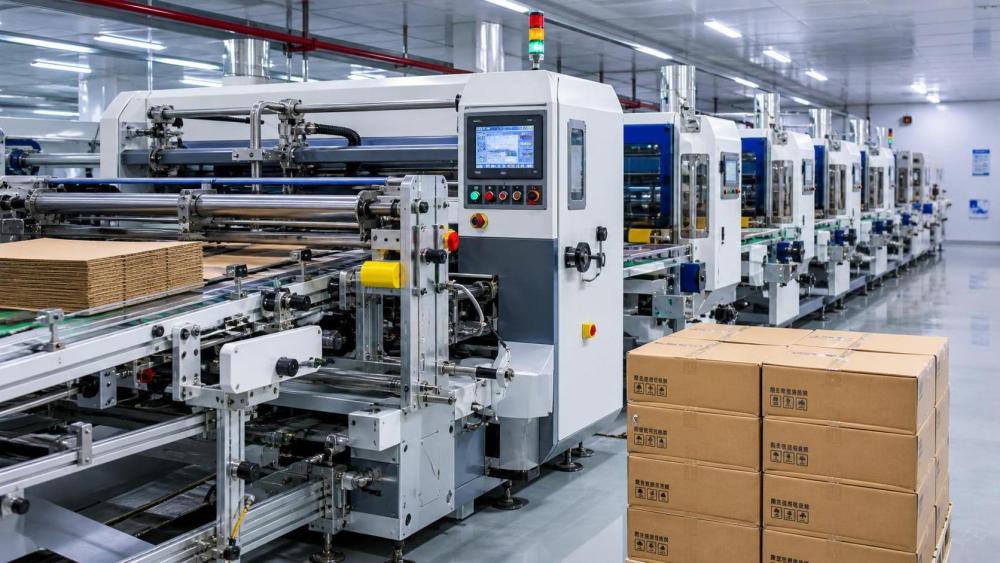
Servo drives, recipe management, automatic size adjustment, robotic feeding, inline inspection, automatic waste removal, and end-of-line handling can add substantially to capital cost. Their value depends on the operating model. A converter running a few long, predictable jobs with experienced operators may recover less value from full automation than a plant handling many short runs, seasonal SKUs, or frequent customer artwork changes.
Automation should be evaluated against specific losses, not treated as a status symbol. If manual setup causes recurring misregistration, slow restarts, or large quantities of setup waste, automated positioning may have a direct commercial case. If the true bottleneck is upstream board availability, drying time, or warehouse flow, adding automation to the converting machine alone may not solve it.
There is also a middle ground. Some buyers specify essential automation on the highest-changeover modules, while retaining manual adjustment where settings are infrequent and easy to verify. This approach can preserve a manageable investment without forcing operators to spend their shift chasing mechanical settings.
Board range and tooling precision are not minor technical details
Corrugated board is a variable material. Flute type, liner quality, moisture condition, warp, recycled content, coating, sheet dimensions, and compression characteristics all affect how reliably it feeds, prints, creases, cuts, and folds. Equipment intended for a broad board range needs more capable feeding, pressure control, registration systems, and often more robust mechanical design. That capability is reflected in the quote.
Precision matters even more where packaging design has little tolerance for error. Retail-ready packs, shelf displays, mailers with intricate locking features, and high-graphic printed boxes demand reliable alignment between print, cut, crease, and glue. In such applications, buyers should not assess a die-cutter merely by whether it can cut a sample blank. They should ask how it maintains repeatability across a production run and how operators compensate for normal board variation.
Tooling belongs in the budget as well. Dies, anilox rolls, printing plates, stripping tools, creasing rules, and glue-system consumables may sit outside the machine quotation. Their lead time, local availability, expected maintenance requirements, and compatibility with future box designs affect the real cost of ownership. An economical machine paired with expensive or difficult-to-source tooling can become a procurement headache.
Digital controls and inspection can protect margin, not just add features
In corrugated conversion, the cost of a bad run is not limited to wasted board. It can include ink, glue, labor, production time, delayed dispatch, rejected customer deliveries, and disruption to downstream packing. That is why control systems deserve more attention than they often receive during quotation comparison.
Features such as job recipes, remote diagnostics, production reporting, register monitoring, glue verification, and camera-based inspection may raise initial investment, but they can make faults visible sooner. Their financial case is strongest where quality claims are costly, production is lightly staffed, or jobs change often. It is weaker when the system generates data that nobody on the factory floor has the time or authority to act on.
The more advanced the converting line, the more important its relationship with upstream processes becomes. Board produced on a corrugator can carry tension, moisture, and warp-related variability into downstream conversion. Likewise, a high-speed inkjet system can introduce requirements around surface treatment, ink behavior, drying, and color control. IPPS follows these intersections closely because machine performance is rarely isolated: web tension control, board formation, print behavior, and post-press accuracy are linked in the finished carton.
Installation, utilities, and integration are where budgets can drift
A supplier’s machine price may exclude items that are essential to operation: freight, unloading, foundations, electrical works, compressed air, extraction, steam or thermal requirements, safety guarding, network connections, commissioning support, or operator training. The exclusions are not necessarily unreasonable. Problems occur when they are discovered after a capital request has already been approved.
Integration cost is particularly relevant for existing plants. A new folder gluer may need to accept blanks from an older die-cutter. A digital printer may need drying and coating steps. Automated bundle handling may require changes to warehouse layout or pallet specifications. When a project includes equipment from several vendors, determine who owns the system-level acceptance criteria. Without that clarity, each party can argue that its own machine performs correctly while the line still fails to meet output expectations.
Energy use should also be evaluated in context. Heavy-duty corrugated operations can involve significant electrical loads, vacuum systems, compressed air, heating, drying, and glue preparation. The relevant question is not whether a supplier claims to be energy efficient, but what utilities are required in the proposed configuration and how those requirements compare under the buyer’s local energy conditions.
After-sales capability can outweigh a lower initial quote
Downtime is where equipment purchasing decisions become painfully real. Before choosing a supplier, verify the service model rather than relying on general assurances. Where are technicians located? Which critical spares are normally stocked? What diagnostic access is available? What are the responsibilities during commissioning? Are software updates, preventive maintenance, and operator refresher training included or separately priced?
For imported equipment, service responsiveness may depend on time zones, language, customs processes, and the availability of locally qualified electrical or mechanical support. A remote connection can solve some control issues, but it will not replace a spare part that is unavailable when a key drive, sensor, bearing, or glue component fails.
This is also where contract wording matters. Acceptance testing should reflect the buyer’s actual materials and representative box formats where feasible, not only an idealized demonstration sample. Clarify what constitutes successful commissioning, which performance conditions apply, and how defects or incomplete interfaces will be handled.
A practical way to compare competing converting proposals
The best comparison is usually a normalized one. Put each proposal against the same production brief: board grades, flute profiles, minimum and maximum blank sizes, box styles, expected order mix, shift pattern, target quality level, available utilities, labor model, and future growth assumptions. Then separate the investment into machine, tooling, installation, integration, training, spares, software, and expected operating inputs.
The corrugated converting solutions price should ultimately be treated as a lifecycle decision. Buyers do not need to purchase every available automation option, nor should they assume the cheapest configuration is disciplined procurement. The sensible choice is the line whose technical scope matches the real work, whose output assumptions can be tested, and whose support model remains credible after the installation team has left the plant.
For packaging businesses responding to e-commerce demand, shorter product cycles, and the shift toward fiber-based alternatives, flexibility increasingly has a measurable cost. The right time to define that cost is before the purchase order—not after production has exposed the gaps in the original specification.
Industry Briefing
Get the top 5 industry headlines delivered to your inbox every morning.
Recommended News