
How Should Buyers Evaluate Tissue Converting After-Sales Support?
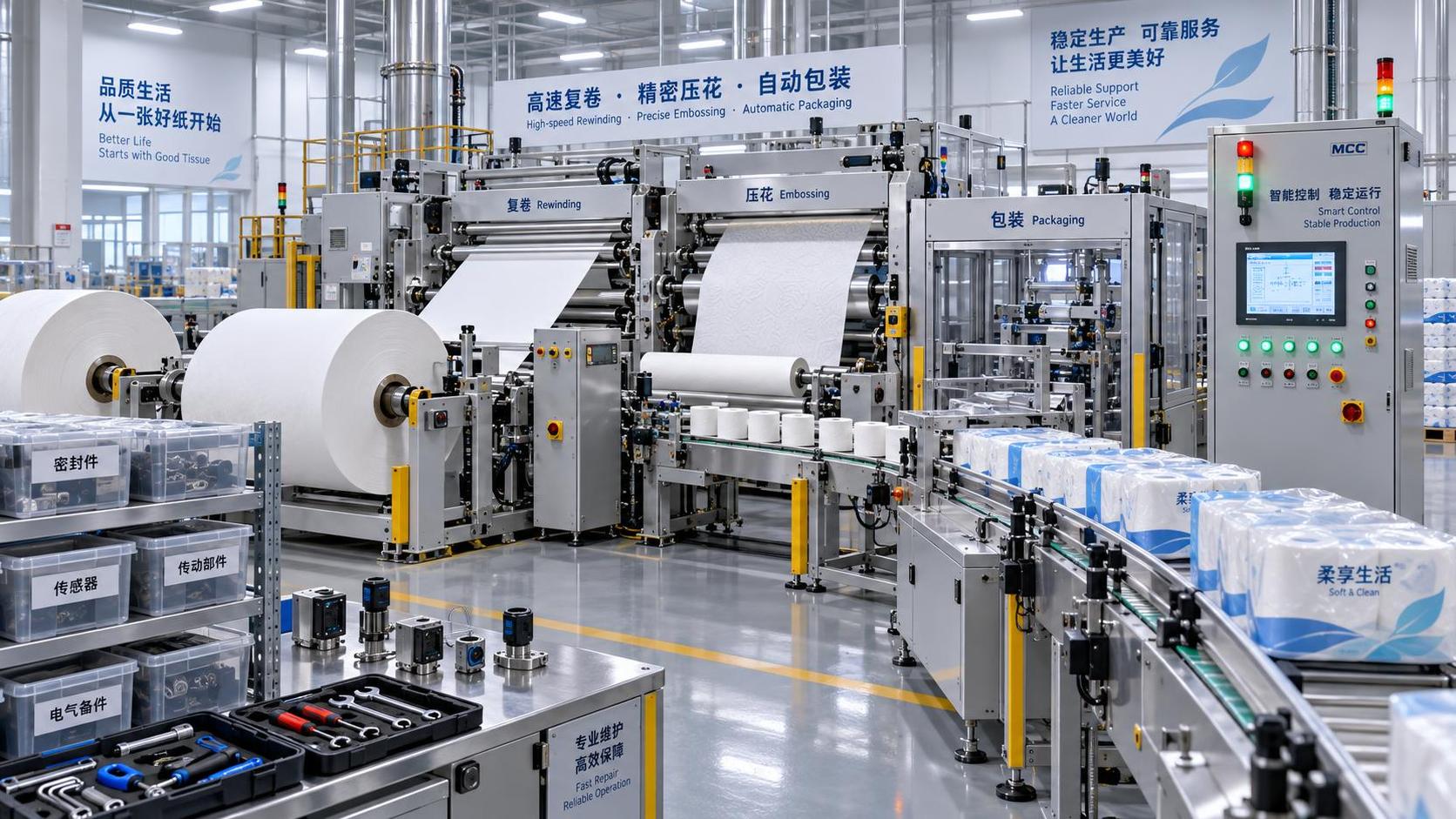
A tissue line can be mechanically sound at commissioning and still become a costly production risk when a rewinder fault, embossing issue, packaging stoppage, or control alarm occurs months later. The immediate concern is not whether a supplier can promise “global service”; it is whether the plant can restore safe, stable output before a short interruption turns into lost orders, excess trim waste, or hygiene-related quality concerns.
To evaluate tissue converting machinery after-sales support, buyers should test the supplier’s service system as carefully as the machine specification. The strongest support offer has clear response commitments, named technical routes, accessible spare parts, usable remote diagnostics, structured operator training, preventive-maintenance support, and service coverage that matches the plant’s location and operating hours. Ask for evidence, process details, and contract language—not broad assurances.
Start with the downtime scenario, not the service brochure
After-sales capability is easiest to judge when procurement, engineering, and production teams picture the events most likely to disrupt their own line. A tissue converter has several interdependent areas: parent-roll handling, unwinding, embossing or laminating, perforation, rewinding, log sawing, interfolding where applicable, and wrapping or cartoning. A fault in one section can starve downstream equipment or leave finished packs waiting for release.
Build evaluation questions around realistic operating situations. For example: a web breaks repeatedly at production speed; a perforation pattern drifts; an embossing roll is changed and registration is unstable; a servo drive generates intermittent alarms; the wrapper rejects acceptable logs; or an operator needs to switch grades under time pressure. The right supplier should explain who receives the request, what information is needed, whether remote access is available, how escalation works, and what happens if the first intervention does not solve the issue.
A supplier that only describes installation support has not yet demonstrated lifecycle support. Commissioning is planned and staffed in advance. Service quality is revealed during an unplanned stoppage, when the local team needs accurate guidance, a replacement part, and a decision path without waiting through several layers of communication.
Examine response time in practical terms
“Fast response” is too vague to compare proposals. Separate the response process into stages and ask which stages are committed in writing. An initial acknowledgement is useful, but it is not the same as a technically qualified diagnosis. Remote troubleshooting is valuable, but it is not a substitute for an on-site visit when mechanical alignment, safety devices, or damaged components must be inspected.
Ask suppliers to distinguish their standard target from emergency treatment and from contractual service-level commitments. Also ask what information the plant must provide to activate support: machine serial number, alarm history, photographs, video, product format, roll data, settings, and recent maintenance actions are common requirements. A well-designed intake process speeds diagnosis; it should not become an excuse to delay it.
Time-zone coverage deserves careful attention. A converting line may run shifts, while the supplier’s central support desk operates during another region’s business day. Check whether an escalation route exists for critical production stoppages and whether the proposed local partner can handle both mechanical service and automation faults. A local contact who can only pass messages to a distant factory may not provide meaningful recovery support.
Spare-parts support is where promises become measurable
Many tissue machine failures can be recovered quickly only when the correct part is available. Buyers should request a recommended spare-parts list separated into commissioning spares, routine consumables, critical operational spares, and long-lead or custom components. That classification helps the plant decide what to keep on site and what can reasonably be held by the supplier.
Do not evaluate the list only by its purchase cost. Ask why each item is recommended, what failure symptom it addresses, its storage conditions, compatibility with the proposed configuration, expected obsolescence risk, and replacement lead time. For controls hardware, clarify the availability of drives, PLC components, safety modules, sensors, encoders, power supplies, and human-machine-interface hardware. For mechanical sections, inspect support for knives, anvils, belts, bearings, pneumatic items, seals, gears, rollers, and parts associated with embossing or perforation assemblies.
Questions that expose spare-parts readiness
- Which critical parts are stocked regionally, and which must be supplied from the manufacturing location?
- Can the supplier identify parts with a single-source dependency or extended manufacturing time?
- How are urgent orders handled, including order cut-off times and shipment coordination?
- Does the machine documentation include part numbers, revisions, drawings where appropriate, and approved substitutions?
- When a component is discontinued, how will compatibility, software changes, and recommissioning be managed?
Parts support also affects product quality. Using an incorrect knife, a worn perforation component, or an unsuitable pneumatic replacement may not stop the machine immediately, yet it can create poor sheet separation, uneven log density, pack defects, or unstable running. A supplier should be able to help the maintenance team recognize wear limits rather than simply sell replacements after failure.
Remote diagnostics should be tested for usefulness and control
Remote access can shorten troubleshooting dramatically when it allows a qualified technician to review alarms, machine states, trends, and relevant parameters. It is especially useful for intermittent control faults, recipe questions, drive-related alarms, and guidance during restart. However, buyers should not treat remote connectivity as a feature that automatically guarantees support quality.
Request a clear explanation of the connection architecture, access permissions, audit records, cybersecurity responsibilities, and the process for granting or revoking access. The plant should know whether remote personnel can only observe data, can guide local operators, or can make parameter changes. Sensitive changes affecting safety functions, motion settings, tension control, or product recipes should have defined authorization rules.
Equally important is the quality of diagnostic records available to the local team. Alarm messages that merely show a code force unnecessary calls and trial-and-error recovery. Better support includes readable alarm descriptions, fault-history retrieval, electrical and pneumatic documentation, parameter backup procedures, and a controlled method for software updates. Ask whether the supplier supplies a current backup after commissioning and how configuration changes are documented over the machine’s life.
Training must prepare people for normal work and abnormal work
A brief handover demonstration is not enough for a line that may run multiple products, shift patterns, and paper grades. Training should be role-specific. Operators need confident startup, shutdown, recipe selection, web threading, basic adjustments, changeover discipline, and safe response to common alarms. Maintenance personnel need deeper instruction on lubrication, inspection points, mechanical adjustment, electrical diagnostics, backup recovery, and component replacement. Supervisors may need guidance on performance records, quality trends, and when to escalate a problem.
Ask to review the training plan before placing the order. It should state the duration, location, language, group size, machine availability needed for hands-on practice, training materials, and whether refresher sessions are available after production begins. The timing matters: initial training before site acceptance helps the team understand the machine, while follow-up training after real production has started can address questions that only arise with actual grades and formats.
Training quality can be assessed through its operating scenarios. Can the supplier show how to recover from a web break without creating unsafe shortcuts? Does the material explain which adjustments affect embossing appearance, perforation consistency, roll hardness, or pack presentation? Are sanitation and housekeeping responsibilities included where they influence dust control, product protection, and safe maintenance access? A useful course leaves behind procedures that a new shift employee can follow, not only knowledge held by the commissioning engineer.
Look for preventive maintenance that fits the converter’s workload
Support should not appear only after a breakdown. A credible preventive-maintenance program identifies inspection intervals, lubrication requirements, cleaning points, calibration needs, wear components, condition checks, and the records needed to spot deterioration. The schedule should account for actual operating conditions: tissue grade, dust level, adhesive use where relevant, product format changes, running hours, and line speed can all affect maintenance needs.
Ask whether the supplier provides planned service visits, remote health reviews, maintenance checklists, and recommendations based on observed wear. More importantly, determine what the visit produces. A useful report identifies findings by urgency, describes the operational consequence of deferring work, lists required parts, and records adjustments made. A vague visit report stating that the machine was “checked” offers little protection against repeat problems.
Buyers should also clarify responsibility boundaries. The supplier may define maintenance actions for the machine, but utilities, compressed air quality, electrical stability, parent-roll quality, adhesives, and upstream or downstream equipment can influence performance. Support works better when both parties agree what operating data will be retained and what site conditions must be verified before a fault is assigned to machine design or service.
Assess local coverage beyond the distance on a map
A nearby office does not necessarily mean capable tissue-converting support. Find out how many technicians are trained on the proposed platform, whether they can work on controls and mechanical systems, what languages they use for documentation and on-site communication, and whether they have access to specialized tools. Ask who covers holidays, peak service periods, and simultaneous customer calls.
Where support is delivered through a distributor or partner, establish the relationship clearly. Does that organization hold parts? Can it perform warranty work? Who owns the technical diagnosis if the local technician and the original equipment supplier disagree? How are software changes, engineering modifications, and root-cause findings transferred back to the machine builder? Ambiguity in this chain often becomes visible only after a difficult failure.
For a highly automated line, the availability of process knowledge matters as much as travel time. A technician may replace a failed sensor quickly, but repeat web instability or poor perforation may require someone who understands the interaction of tissue properties, tension settings, speed profiles, and mechanical condition. Ask how such cases are escalated and whether remote specialists can work directly with the plant team.
Put support obligations into the commercial evaluation
After-sales support should be scored alongside throughput, format range, energy use, and purchase price. During proposal review, give each supplier the same fault scenarios and request written answers. Compare not only the stated service scope but also the assumptions, exclusions, and customer responsibilities behind it. This makes differences visible before negotiations become focused solely on equipment cost.
Contract language should cover warranty scope, service request channels, response definitions, travel and labor conditions, remote-access terms, spare-parts pricing principles, documentation delivery, training scope, software and controls support, and the process for reporting unresolved technical issues. Avoid treating every item as an optional add-on without considering its effect on uptime. A lower initial price can lose value quickly if the line lacks critical spares, trained operators, or a reachable escalation route.
Before final selection, involve the people who will use the support: maintenance leaders, production supervisors, automation personnel, quality staff, and purchasing. Their questions tend to uncover gaps that a specification comparison misses. The practical standard is straightforward: when the line is stopped, product quality is drifting, or a shift team faces an unfamiliar alarm, can this supplier provide timely, technically relevant help through a documented path? A buyer that can answer that question with evidence is evaluating after-sales support on the basis that matters most.
Industry Briefing
Get the top 5 industry headlines delivered to your inbox every morning.
Recommended News