
Which sustainable packaging trends matter most for industrial goods?
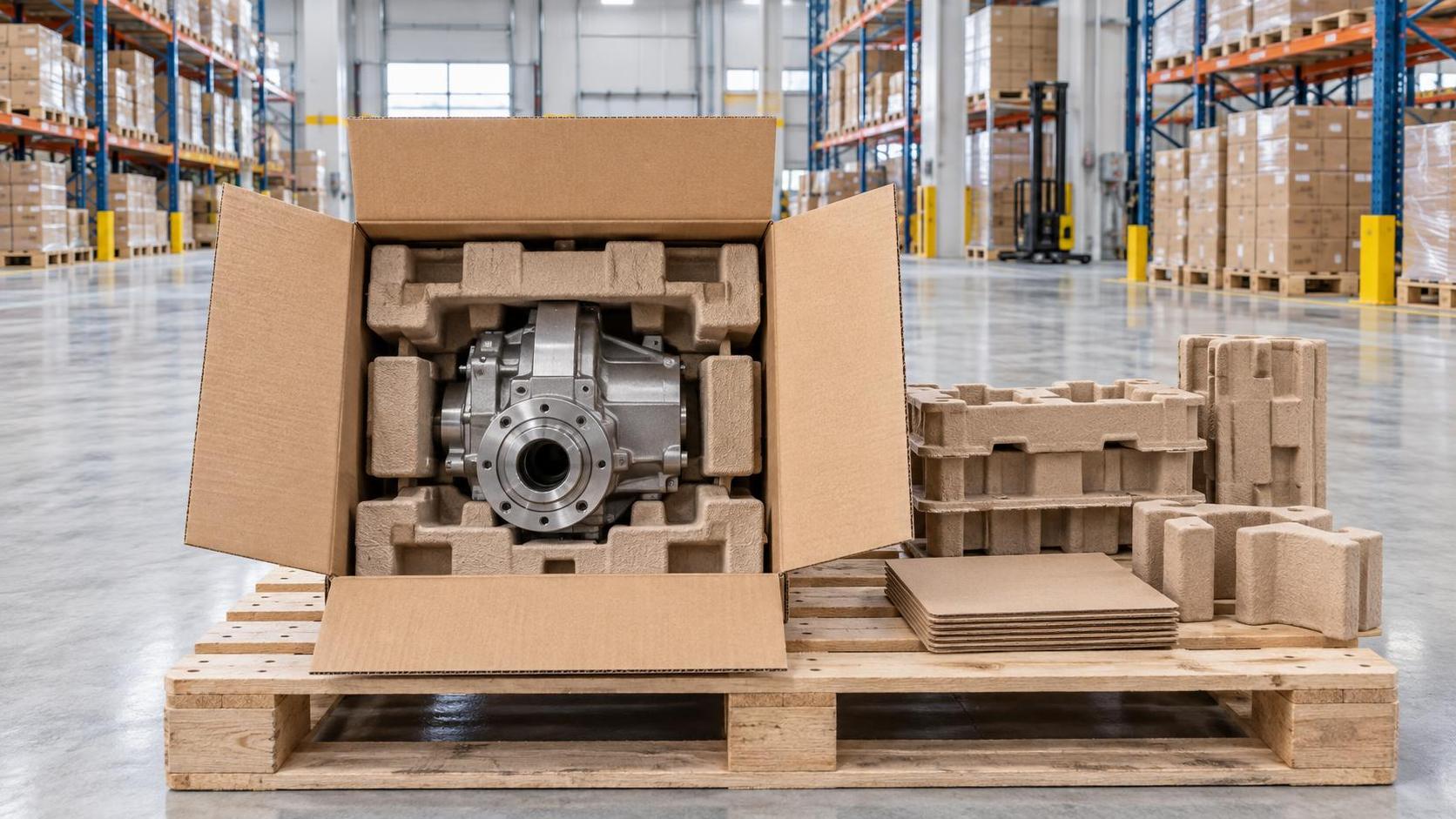
For industrial goods, the sustainable packaging trends that matter most are the ones that preserve product protection while reducing material use, simplifying recovery, and keeping high-volume operations stable. A lighter shipper that fails after humidity exposure, a fiber substitute that cannot tolerate abrasion, or a recyclable structure contaminated by incompatible coatings does not deliver a credible environmental improvement. The strongest shifts are therefore moving packaging design closer to real transport conditions, conversion limits, and end-of-life pathways.
The priority is changing from selecting a material with a favorable label to engineering a package as a working system. Board grade, flute geometry, adhesive application, print coverage, closure design, pallet pattern, warehouse climate, and destination recycling infrastructure all affect the final result. The top trends in sustainable packaging for industrial goods reflect that broader view.
Right-sized corrugated protection is replacing excess material
Corrugated packaging remains central to industrial distribution because it can combine low mass, compression resistance, printability, and established fiber recovery routes. The current trend is not simply toward thinner board. It is toward right-sized board construction: matching liner strength, medium profile, flute combination, and box geometry to the actual load path.
Many industrial packs carry a product safely because of empty-space fill, oversized panels, or heavy board that compensates for weak structural design. Reducing caliper without revisiting those conditions can create corner collapse, panel bulge, insufficient stacking strength, or product movement. A more effective redesign begins with where the load is transferred. A dense metal component, for example, can concentrate force at the bottom panel and corners, while a bulky but light assembly may be limited by top-load compression during storage. These require different board and insert strategies.
Flute selection also needs to match the handling environment. Fine flutes offer good print surfaces and can support compact retail-ready packs, but they are not automatically the best choice for long distribution cycles or high point loads. Larger flute profiles provide cushioning and stiffness, yet their performance is influenced by moisture uptake, converting quality, and the way creases are formed. A board that performs well in a dry compression test can behave differently after exposure to humid warehouses or long sea transit.
Right-sizing increasingly includes the pallet rather than stopping at the carton. A reduced footprint may lower fiber consumption per pack but leave inefficient pallet gaps, raise stretch-film use, or create unstable column stacks. The useful comparison is delivered product per stable load, with damage, rework, and return packaging included in the assessment.
Fiber-based substitution is becoming more selective
Replacing plastic with paper or molded fiber is a visible trend, especially for trays, spacers, corner protection, protective wraps, and secondary packs. Its value is strongest where the packaging function is primarily separation, blocking, cushioning, or surface protection. Industrial components with controlled shapes, moderate handling stress, and dry supply chains are often suitable candidates.
Substitution becomes harder when a polymer part provides several functions at once: moisture barrier, puncture resistance, corrosion control, dust exclusion, static control, sealing, and high-energy cushioning. Replacing that item with a fiber alternative without separating the functions can produce a package that looks simpler but creates quality failures. The design question should be: which protection function is genuinely needed, at what duration, and under which exposure conditions?
For example, molded fiber can replace a foam end cap when its geometry restrains the product and the distribution route has predictable shock exposure. It is less suitable when the packed surface is highly sensitive to abrasion or when the part must remain dimensionally stable after extended moisture exposure. A hybrid structure may remain justified where a minimal protective layer prevents corrosion or friction while fiber carries most of the blocking and stacking load. Material reduction is still possible, but it comes from assigning each layer a clear job rather than treating every plastic component as unnecessary.
Coatings deserve equal scrutiny. Barrier treatments, release layers, laminations, and high-coverage functional inks can change how a fiber pack is sorted, repulped, or accepted locally. A paper-based appearance is not enough evidence of recoverability. The relevant evidence concerns the finished pack, including labels, tapes, windows, coatings, and residues left after use.
Design for disassembly is displacing complex mixed-material packs
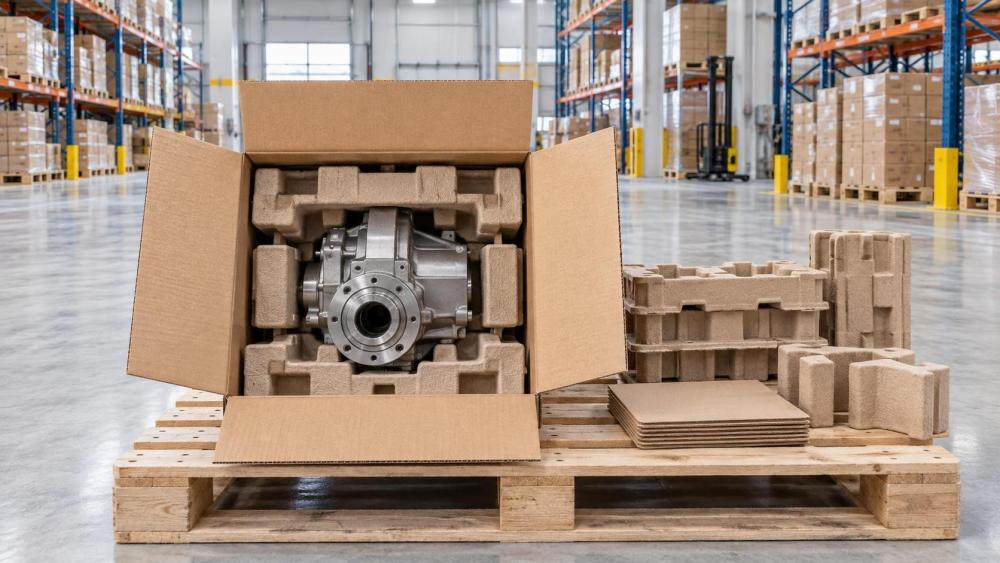
Industrial packaging often accumulates materials through incremental fixes: a corrugated carton, plastic bag, foam blocks, reinforced tape, a paper label, metal clips, and several internal pads. Each addition may solve a local problem, but the final assembly can be difficult to separate and expensive to process after delivery.
Design for disassembly favors fewer material families, accessible separation points, and closures that do not force a recycler to deal with a fused composite. This does not require every pack to be made from a single substrate. It requires the non-fiber or non-recyclable portion to be proportionate, removable, and technically justified.
- Integrated corrugated locking features can remove some tapes, staples, and separate plastic retainers when the pack is exposed to normal handling rather than extreme vibration.
- Fiber-based dividers and folded inserts can consolidate multiple loose components, provided their creases retain position through packing and unloading.
- Clearly separated protective layers are preferable to permanently bonded combinations when a barrier film or static-control bag remains necessary.
- Water-based labeling and adhesive systems require validation at the actual application speed and storage temperature; a low-residue adhesive that opens prematurely creates a different waste stream through repacking and damage.
Glue-free designs are receiving more attention, but they are not universally superior. Locking tabs can increase die-cut complexity, consume board area, and weaken panels if their placement interrupts a critical compression zone. High-speed folding lines also impose practical limits on locking geometry. A conventional adhesive joint may use less material overall than a larger self-locking blank, particularly for heavy products. The comparison should include blank yield, make-ready waste, line speed, closure integrity, and recovery outcomes.
Digital print is reducing obsolescence and improving packaging control
Digital printing is a sustainability trend when it changes operational behavior, not merely when it adds variable graphics. Short-run and versioned production can reduce obsolete preprinted inventories, avoid plate-making for frequent artwork changes, and support localized instructions without holding multiple large print stocks. This is useful for industrial goods with evolving safety information, service-part identification, regional handling marks, or product configurations.
The operational benefit depends on print quality being stable on the intended substrate. Corrugated surfaces vary in porosity, smoothness, moisture, and crush condition. Ink spread and color density can shift between board grades, and barcodes or small technical text may degrade if the print system, ink set, and board surface are not qualified together. A design approved on a coated sample may not remain legible on a recycled-content liner with a more open surface.
Variable data also supports traceability where it has a defined process role. Serialized labels, lot references, handling instructions, and scan-ready codes can link a pack to production and movement records. Yet traceability should not be confused with sustainability by itself. The environmental value appears when accurate identification prevents misrouting, reduces disposal caused by specification errors, enables reuse loops, or supports controlled recovery. Poor code placement, low contrast, or print distortion can interrupt the process at the dock despite a well-designed digital workflow.
Automated conversion is being judged by waste stability, not speed alone
High-output converting equipment can reduce waste when setup, web control, scoring, die-cutting, folding, and gluing remain stable over long runs. The relevant trend is greater use of process control to prevent defect creation upstream. Off-register print, inaccurate creases, uneven glue patterns, warped blanks, and tension variation all consume material before a finished box reaches a shipping line.
For corrugated operations, moisture balance is a recurring issue. Board that is too dry may crack at scores and lose flexibility; excessive moisture can reduce stiffness and distort print or die-cut accuracy. Changing paper grades to raise recycled fiber content can alter these operating windows. That does not make the grade unsuitable, but it means the corrugating, converting, and quality settings should be adjusted as part of the material change.
Folder-gluer performance matters especially where a package is redesigned to use less board. Reduced safety margin in the blank can make folding precision and adhesive placement more consequential. Bond strength should be evaluated after the relevant storage and transport exposure, rather than only immediately after conversion. Cold conditions, dust on the glue flap, surface treatment, and compressed production schedules can each affect bond formation.
Waste measurement should separate startup losses, changeover scrap, recurring defects, and damage-related repacks. Combining them into one total hides the cause. A material change that reduces trim waste but leads to more crease failures needs a different response from a job with excessive make-ready sheets. This distinction determines whether the corrective action belongs in structural design, supplier specification, machine settings, or maintenance.
Source traceability is moving from a claim to a packaging requirement
Fiber sourcing and chain-of-custody information are gaining importance as commercial requirements and forest-related due-diligence expectations become more demanding. The practical trend is toward records that connect a finished packaging specification to its paper grade, mill documentation, converter batch, and shipment. Traceability is particularly relevant when several grades are qualified for the same pack or when supply disruptions cause substitutions.
Documentation alone does not establish equivalent performance. A substitute liner or medium can differ in basis weight, stiffness, surface characteristics, or moisture behavior even when it appears similar in a purchasing description. Any sourcing change should preserve the package's functional specification: compression resistance, puncture resistance, print readability, seal behavior, and intended recovery route. Traceability becomes useful when it makes that comparison possible without reconstructing the supply history after a failure.
Claims need the same discipline. “Recyclable,” “renewable,” “plastic-free,” and “lower impact” describe different attributes and should not be used interchangeably. A pack may be technically recyclable yet poorly accepted in the regions where it is discarded. It may contain renewable fiber while still using a non-removable barrier layer. Clear internal definitions prevent sales language from outrunning the engineering evidence.
Reuse is growing where reverse logistics already exists
Reusable industrial transit packaging is most credible for closed or predictable flows: components moving between plants, service parts returned through established channels, or repetitive deliveries to a limited network. Durable totes, sleeves, pallets, and protective dunnage can reduce single-use consumption across repeated cycles, but only when return, inspection, cleaning, and repair are operationally real.
Distance alone is not the deciding factor. A regional route with uncertain returns can be less suitable than a longer flow where empty packaging is consistently recovered. The pack also needs an identification method that survives handling and a rule for removing damaged units before they compromise product protection. Reuse programs fail when packaging ownership, return responsibility, and loss handling remain undefined.
For one-way export shipments, optimized corrugated and simplified protective structures often remain the more practical path. The best sustainable packaging choice is therefore linked to the product's logistics pattern, not to a fixed hierarchy of materials.
Choosing among trends requires a functional baseline
A useful baseline starts with the current package’s actual job: product weight and fragility, stacked load, vibration exposure, climate, shelf time, manual or automated handling, required identification, and destination recovery conditions. Each proposed change should then be tested against the same job. This keeps an attractive material substitution from being approved on appearance while its protection burden is quietly shifted to additional void fill, secondary wrapping, or higher damage allowances.
The most durable direction is packaging that uses only the protection required, converts reliably, communicates accurately, and can be separated or recovered through the routes available after use. Industrial goods rarely benefit from a single universal material answer. They benefit from packaging specifications that connect environmental intent to the physical realities of transport and production.
Industry Briefing
Get the top 5 industry headlines delivered to your inbox every morning.
Recommended News