
How trends in automated packaging are changing line flexibility
The latest trends in automated packaging are reshaping how production lines handle changing formats, shorter runs, and demand for sustainable materials. For technical evaluators, the challenge is to determine which advances—from digital printing and automated changeovers to integrated control systems—deliver flexibility without compromising throughput or product quality. The answer is rarely found in a single machine. It lies in how reliably the entire line can move from one job to the next.
Picture a corrugated packaging operation switching from a standard shipping case to a smaller, digitally printed promotional box. The print file changes quickly, but guides still need adjustment, the blank may behave differently in the feeder, and the folder-gluer must apply adhesive in a new pattern. If inspection settings and downstream packing remain tied to the previous format, the apparent speed of one operation means little. Modern flexibility is increasingly about coordinating those transitions.
What flexibility means on a packaging line
Flexibility is often described as the ability to run more formats. For an evaluator, that definition is incomplete. A genuinely flexible line must accommodate a defined range of materials, dimensions, graphics, run lengths, and production sequences while maintaining acceptable quality and predictable output.
Four capabilities deserve separate attention:
- Format flexibility: How easily can the line handle different box sizes, flute profiles, or product configurations?
- Job flexibility: How quickly can it switch artwork, production quantities, adhesive patterns, and inspection criteria?
- Material flexibility: Can it process changes in board grade, recycled content, coatings, or paper-based substitutes without excessive waste?
- Operational flexibility: Can operators recover from interruptions, introduce new recipes, and maintain equipment without relying on a small number of specialists?
These capabilities are related, but they are not interchangeable. A machine with a wide format range may still require a lengthy manual setup. Similarly, a fast changeover is of limited value if the new material causes repeated jams or weak bonds.
Trends in automated packaging are shifting the bottleneck
Packaging demand is becoming harder to serve with a single, unchanging production recipe. E-commerce introduces a broad mix of shipping formats, while brand owners may request regional artwork, promotional versions, or smaller replenishment orders. At the same time, packaging converters are assessing lighter structures and alternatives to plastic components.
These pressures do not eliminate the need for speed. They change where speed matters. A high nominal output is attractive on a long, stable run, but frequent job changes expose losses during setup, adjustment, inspection, and restart. The relevant question becomes: how much saleable output can the line produce across the actual schedule?
This is why automation investment is moving beyond individual high-speed assets toward repeatable setup, connected workflows, and faster identification of process variation. The trend is especially visible where printing, corrugated converting, die-cutting, and folder-gluing must work as one production system.
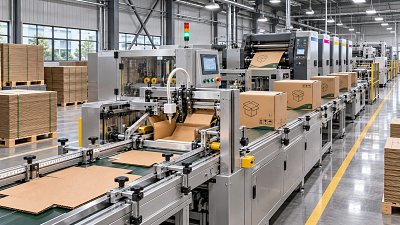
Digital printing makes artwork changes easier—but raises integration questions
Industrial digital printing can reduce dependence on printing plates and make version changes more practical. For corrugated packaging, this opens opportunities for short runs, localized designs, serialized information, and late-stage artwork updates. When demand is uncertain, producing closer to the required quantity may also reduce obsolete printed stock.
For technical evaluators, however, the print engine is only part of the decision. Board surface, absorbency, flute structure, ink compatibility, and drying behavior affect print quality and downstream handling. A design that looks acceptable on a smooth sample may behave differently on the production board chosen for cost or strength reasons.
Check how artwork and job data move from prepress to the press and then to converting equipment. Can operators confirm that the correct file, substrate, and order are matched? Is there a practical method for checking color consistency, barcode readability, and variable data? A flexible print workflow should make these controls easier, not create a separate island of digital complexity.
Automated changeovers are becoming a competitive lever
Recipe-driven setup can move guides, adjust settings, load adhesive patterns, and configure inspection parameters for a new job. Depending on the equipment, some adjustments may be automatic while others remain assisted or manual. The distinction matters: a stored recipe does not guarantee that the machine can physically reach every setting without intervention.
On a folder-gluer, for example, evaluators should examine the time required to set carriers, folding rails, glue application, and quality controls for representative carton styles. On die-cutting equipment, the practical changeover may also include tooling, stripping arrangements, sheet handling, and verification of crease quality. The fastest isolated adjustment is not necessarily the fastest production restart.
Ask suppliers to demonstrate a complete transition between two realistic jobs, including clearance of the previous run and approval of the first acceptable output. Record who performs each step, what tools are needed, and which adjustments depend on operator judgment. This makes differences between advertised automation and usable flexibility much easier to see.
Connected controls improve coordination, not just visibility
Integrated control systems are increasingly used to link machine settings, production orders, inspection results, and downtime information. In a paper-based packaging line, this can support more consistent handoffs between printing, cutting, folding, gluing, and packing. It can also make recurring setup problems visible across shifts rather than leaving them in individual operators’ notes.
Yet connection alone does not solve a process problem. Data must have a clear purpose and enough context to support action. A line-speed value is useful, for instance, only when it can be interpreted alongside job type, material, stoppages, and quality rejects.
Questions to bring to an integration review
- Which parameters can be exchanged automatically between machines, and which must still be entered by hand?
- How are job identifiers maintained across printing, converting, and inspection?
- Can the system record the reason for a stop or reject in a way operators will actually use?
- What interfaces are available for existing equipment, and who is responsible for testing them?
- How are access permissions, software updates, backups, and remote support managed?
Open communication standards can make integration easier, but compatibility should be verified at the level of the required data and functions. Two machines that communicate are not necessarily two machines that coordinate a changeover safely and accurately.
Inspection is moving closer to real-time process control
As job variation increases, quality assurance must keep pace. Vision systems and sensors can inspect print position, codes, blank presence, fold alignment, glue application, or other characteristics, depending on the line configuration. Their value is greatest when they detect meaningful defects early enough to limit waste and prevent faulty packs from continuing downstream.
Detection performance should be assessed against the actual defect types and materials in the plant. Gloss, board texture, dust, lighting, and product movement can all complicate inspection. Frequent false rejects can be as disruptive as missed defects if operators begin overriding alarms to keep the line running.
During evaluation, request trials with acceptable samples as well as deliberately introduced defects. Establish how inspection recipes are created and approved, what happens when the system loses confidence, and whether a reject can be traced to a specific job or period. An inspection system should support operator decisions, not simply generate more alarms.
Material change is testing the limits of automation
Paper-based packaging is being reconsidered across many applications as companies assess material use, recyclability, and shipping performance. This creates opportunities for equipment suppliers and converters, but it also exposes a common misconception: replacing a material is not merely a purchasing decision.
A lighter board may respond differently to tension, feeding, scoring, folding, or compression. Changes in recycled fiber content or surface treatment can influence print appearance and adhesive performance. A paper-based alternative to a plastic component may need a different sealing method or a revised pack geometry.
For corrugators and converting lines, a material trial should follow the substrate through the whole process. Watch for sheet flatness, registration stability, dust, cracking at creases, glue penetration, and finished-pack performance. Where relevant, include storage and transport conditions in the assessment. A material that runs for a short demonstration but creates problems after a shift change or a warehouse stay has not yet proved its suitability.
Sustainability claims also require care. Lower material use or improved compatibility with a recycling stream may be valuable, but the outcome depends on the full pack design and local recovery infrastructure. Equipment flexibility supports experimentation; it does not by itself establish an environmental benefit.
How to compare flexibility investments on equal terms
Before comparing suppliers, define a representative production mix rather than a single ideal job. Include the largest and smallest common formats, a demanding substrate, a short run, and at least one change that requires different print or glue settings. If a proposed material is strategically important, include it in the trial even if volumes are still uncertain.
Then evaluate performance across the production cycle:
- Changeover duration: Measure from the last acceptable unit of one job to the first acceptable unit of the next, and agree on the measurement method.
- Saleable output: Consider good units produced over the scheduled period, not only peak machine speed.
- Setup waste and rejects: Separate losses at startup from defects that appear during stable running.
- Labor and skills: Identify the number of people, training, and specialist intervention needed for routine changes.
- Recovery: Observe how the line resumes after a jam, material splice, inspection fault, or planned stop.
- Lifecycle requirements: Review maintenance access, consumables, spare parts, software support, and the effort needed to add future formats.
It is also worth modeling a less comfortable schedule. A line optimized for long runs may be the right choice when order patterns are stable; a more automated configuration may justify its complexity where changeovers are frequent. The decision depends on the plant’s real mix, not on a generic promise that automation always improves flexibility.
Where technical evaluators should focus next
The most consequential trends in automated packaging point toward coordinated, repeatable production rather than isolated machine speed. Digital printing can make version changes more practical. Automated setup can reduce dependence on manual adjustment. Connected controls and inspection can reveal problems sooner. New materials can broaden design choices, provided the line can process them consistently.
None of these advances removes the need for disciplined trials. The strongest evaluation follows a job from incoming board to finished pack, includes the people who operate and maintain the equipment, and tests the changes that production planners expect to face. That is where flexibility becomes more than a specification: it becomes a measurable ability to respond when the next order is different from the last.
Industry Briefing
Get the top 5 industry headlines delivered to your inbox every morning.
Got questions about the latest insights discussed here, or seeking customized strategic advice for your business? Drop us a line below, and let the think-tank experts at IPPS help you out.
“We respect your privacy. Your information is strictly confidential.”
Recommended News