
Which carton box finishes resist scuffing in retail packaging?
Anti-scuff film laminates, abrasion-resistant UV coatings, and purpose-formulated aqueous coatings are the main finishes to evaluate for scuff-resistant retail cartons. Anti-scuff laminates are often a strong starting point for demanding handling and dark matte graphics; UV coatings can provide durable protection without a separate film layer; aqueous coatings suit many moderate-exposure applications. These are screening directions, not a universal ranking: formulation, adhesion, coverage, and processing determine actual performance.
A carton can leave the press looking clean, then develop pale streaks as boxes rub together during packing, transport, or shelf replenishment. Those marks can make an undamaged product appear worn. Selecting carton box finishing for retail packaging therefore requires more than comparing fresh samples: the finish must protect the printed surface under representative contact while remaining compatible with creasing, gluing, and the intended recovery route.
Identify what is being damaged before changing the finish
“Scuffing” can describe several failures that need different remedies. Ink transfer, surface polishing, scratches, and coating delamination may look similar at a glance, but a harder coating will not necessarily solve all of them.
- Colored transfer onto the opposing surface: investigate ink drying or cure, ink-to-board adhesion, and whether the protective coating forms a continuous layer.
- Shiny patches on a matte panel: the surface may be burnishing rather than losing ink. A finish can pass an ink-transfer check yet fail the appearance requirement.
- Fine lines or grooves: inspect for abrasive particles, rough contact surfaces, or localized pressure. Sliding-rub resistance does not establish scratch resistance.
- Flaking or peeling: check adhesion between board, ink, primer, coating, and laminate. Increasing surface hardness will not repair a weak underlying interface.
- White lines along folds: examine crease geometry, board condition, grain direction, and finish flexibility. This is not necessarily a face-scuff problem.
Record where the damage occurs. Marks concentrated beside glue flaps suggest a different contact mechanism from broad polishing across front panels. Compare cartons before and after folder-gluing, case packing, and transport to locate the stage where damage first appears.
Compare finish families against the actual exposure
Anti-scuff laminates: specify the surface treatment, not just the film
A laminate creates a separate protective layer over the print. However, “matte laminated” does not mean “anti-scuff.” Standard matte films can show polishing or scratches, especially over black, navy, and other dark solids. Ask for the exact anti-scuff grade and its intended application rather than accepting a generic film description.
BOPP and PET are among the film materials used in packaging, but polymer identity alone does not establish the finished surface’s abrasion resistance. Surface treatment, protective topcoat, adhesive, thickness, and lamination conditions all matter. Soft-touch films also require separate assessment: tactile appeal is not evidence of resistance to rubbing, fingerprints, or burnishing.
Choose a laminate candidate when broad face protection is important, then verify its limits. Grit can still scratch a protected surface; a weak adhesive bond can permit lifting; and folds may expose weaknesses that flat-sheet samples conceal.
UV coatings: durable protection depends on cure and adhesion
Abrasion-resistant UV coatings can provide a protective surface with high gloss or a specified matte appearance. The useful distinction is not simply “UV versus aqueous,” but whether the selected chemistry cures properly over the actual ink system and remains attached through handling and converting.
Insufficient cure can leave a vulnerable surface or create blocking and transfer problems. An overly brittle coating may survive flat rubbing but crack at a crease. Verify the supplier’s recommended process window, including compatibility with conventional UV or LED-UV equipment where applicable. Lamp type, output, line speed, coating application, and ink coverage belong in the qualification record.
Spot UV protects only the areas it covers. A decorative logo treatment will not prevent surrounding dark artwork from scuffing. Where protection is the objective, map coating coverage to the contact areas rather than assuming a decorative finish protects the whole panel.
Aqueous coatings: assess the abrasion-resistant grade
Aqueous coatings are worth screening when handling exposure is moderate and a film-free construction is preferred. Purpose-formulated abrasion-resistant grades can perform differently from standard gloss, satin, or matte coatings. Surface slip additives may reduce friction, but their presence does not prove that the carton will retain its appearance.
Drying capacity is a practical constraint. Residual moisture, uneven application, or premature stacking can cause blocking or inconsistent protection. Request samples made under realistic production conditions, including expected drying and stacking conditions, rather than relying exclusively on carefully prepared laboratory drawdowns.
Aqueous does not automatically mean harmless to gluing, universally repulpable, or suitable for every product category. Those properties need confirmation for the complete coating system and carton construction.
Dark matte cartons need an appearance-based test
Dark solids reveal small surface changes because scratches and polished areas contrast with the surrounding finish. Matte surfaces can become visibly glossier where contact alters their microtexture, even when no ink transfers. Gloss finishes have different vulnerabilities: fine scratches may become conspicuous under directional light.
Compare samples under both diffuse illumination and oblique light. Include the actual artwork, especially large dark panels, areas beside embossing, and surfaces likely to contact neighboring cartons. A white or lightly printed test sheet can conceal failures that become obvious on the retail design.
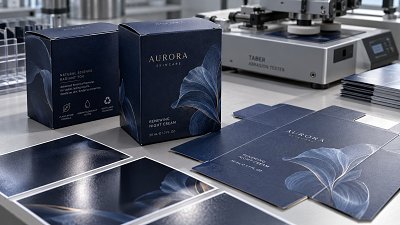
Separate appearance acceptance from material-loss acceptance. “No visible ink transfer” is useful, but incomplete. A practical evaluation should also address polishing, haze, scratches, coating lift, and whether branding remains legible and visually consistent.
Run rub testing that represents the packaging route
A controlled rub test is useful for comparing candidates. ASTM D5264 provides a recognized practice for evaluating abrasion resistance of printed materials using a Sutherland-type rub tester, but citing the practice alone does not define an acceptance threshold. Load, cycles, contact material, conditioning, and the assessment method must be specified.
- Define the contact pair. Test printed face against printed face where adjacent cartons rub. Use the relevant corrugated liner or other material where that is the actual contact surface.
- Use production-representative samples. Keep board grade, print process, ink coverage, and artwork consistent across candidates. Include a current or known reference construction.
- Control sample age and conditioning. Record time since printing, coating, or lamination and the conditioning environment. Where relevant, compare early handling with performance after full drying, cure, or bond development.
- Agree on severity before comparison. Set load and cycle conditions around the exposure being investigated. Do not compare supplier results generated under different conditions as though they were equivalent.
- Assess both surfaces. Inspect the carton sample and counterface for transfer, polishing, scratching, or material loss. Use repeat samples to identify variability.
- Confirm on converted cartons. Follow flat-sample screening with folding, packing, and handling trials. Flat rubbing cannot reproduce corner pressure, vibration, or all transport contacts.
Dry rub, wet rub, and scratch testing answer different questions. Add moisture exposure only where condensation, humid storage, or wet handling is plausible. Use a separate scratch assessment when fingernails, shelf fixtures, or particles are responsible for the damage. A finish should not be rejected for an irrelevant exposure—or approved on a test that misses the real one.
Check converting performance before approving the winner
A highly protective face finish can still cause production failures. Low-friction surfaces may change feeding, stacking, or carton stability. Coatings and films can reduce adhesive wetting if they enter glue areas, while stiff or brittle constructions may crack at folds.
Run the candidate through the intended die-cutting, creasing, and folder-gluing process. Examine creases for whitening or lifting, check adhesive bonds after the specified setting period, and inspect surfaces for marking from belts, guides, or tooling. Preserve uncoated glue windows where required by the adhesive and construction.
Digital printing introduces another interface to qualify. Toner, liquid electrophotographic inks, and inkjet systems do not present identical surfaces to coatings or laminating adhesives. Test the actual printed construction and any primer or pretreatment; approval on offset-printed board is not transferable evidence.
Also inspect raised decoration. Embossed features and foil edges can concentrate contact pressure, so the surrounding protective finish may pass a flat rub test while the decoration remains vulnerable. Protective coverage and packing orientation may need adjustment alongside the finish.
Use recyclability and cost as qualification gates
Film lamination adds material and can affect fiber recovery, but a coating-only structure is not automatically recyclable in every collection and processing system. Assessment depends on the board, coating or film, adhesive, coverage, and local recovery route. Request evidence relevant to the complete carton construction and intended market rather than accepting a broad material claim.
Where avoiding plastic film is a design requirement, screen abrasion-resistant aqueous and UV candidates first. If they fail realistic handling tests, investigate artwork changes, contact reduction, or secondary-pack adjustments before assuming a heavier finish is the only option.
Compare total converted-carton cost rather than coating price alone. Include application, drying or curing demand, lamination operations, line-speed effects, spoilage, and any packing changes. A nominally cheaper coating is not economical if its process window cannot be held consistently.
Write the specification around observable performance
Do not purchase against “scuff-resistant finish” as a standalone description. Record the approved board and ink system, finish grade, coverage, application controls, curing or drying requirements, and glue-area exclusions. Attach retained reference samples showing acceptable appearance.
The acceptance requirement should identify the test method, counterface, conditioning, load, cycles, and inspection conditions. State which outcomes are unacceptable: exposed board, visible ink transfer, delamination, or burnishing beyond the agreed reference. If gloss or color measurements support evaluation, define the measurement procedure and correlate readings with visual acceptance rather than inventing a universal limit.
For demanding dark matte cartons, begin qualification with a genuine anti-scuff laminate and suitable abrasion-resistant coating alternatives. For routine exposure with a film-free requirement, start with aqueous and UV candidates on the actual print construction. Approve the option that passes both representative surface testing and converted-carton trials—not simply the one with the strongest finish name.
Industry Briefing
Get the top 5 industry headlines delivered to your inbox every morning.
Got questions about the latest insights discussed here, or seeking customized strategic advice for your business? Drop us a line below, and let the think-tank experts at IPPS help you out.
“We respect your privacy. Your information is strictly confidential.”
Recommended News