
What determines glue-free packaging equipment cost?
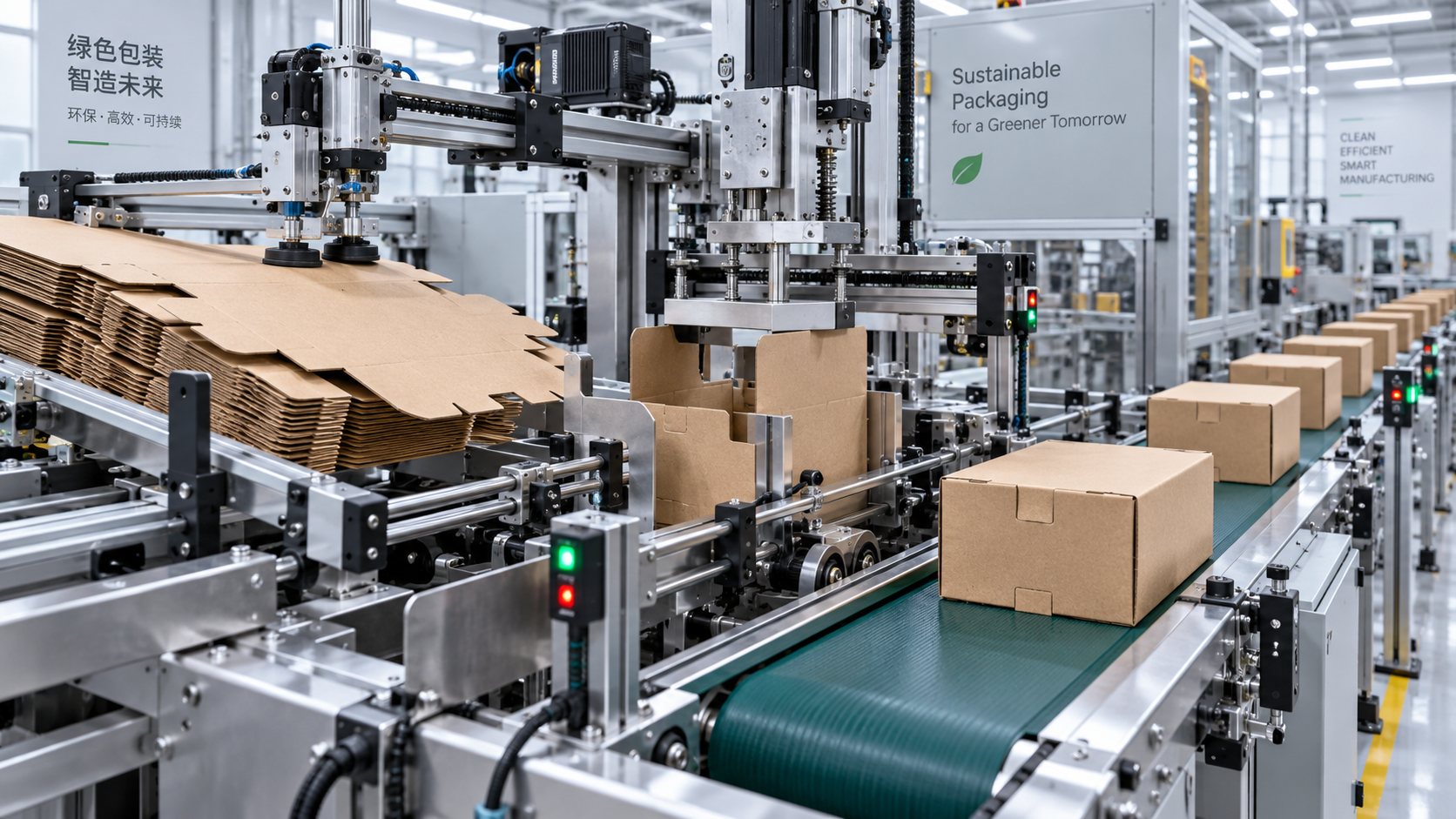
A packaging line may look economical on a quotation and still become expensive once it reaches the factory floor. This often happens when a buyer compares only the purchase price of a glue-free forming machine with a conventional folder-gluer, then discovers that board variation, changeover frequency, tooling, operator intervention, or downstream packing requirements alter the real economics.
Glue-free packaging equipment cost is determined by the production task the machine must perform, not by the absence of adhesive alone. The initial equipment price is influenced by speed, pack geometry, material handling, forming method, automation, tooling, controls, and integration scope. The larger decision is total cost of ownership: material yield, labor, energy, maintenance, rejected packs, spare parts, uptime, and the cost of meeting sustainability or recyclability requirements.
The forming method sets the starting cost range
“Glue-free” can describe several very different packaging approaches. Some machines form cartons through mechanical locks, tuck tabs, slots, folds, or interlocking panels. Others use heat sealing, ultrasonic bonding, water activation, pressure-based locking, or paper-molding processes. Equipment designed for one method may not be able to run another without major changes.
A simple die-cut board with self-locking tabs may require relatively straightforward feeding, creasing alignment, folding stations, and compression components. By contrast, a package that must be shaped around a product, locked at several points, and held square during high-speed discharge needs more controlled motion, more sensors, and a more robust forming section. The cost rises because the machine must repeatedly position the pack within tight tolerances rather than merely apply adhesive and hold a seam closed.
Procurement should first define the intended closure principle. A machine supplier cannot price the right configuration until the buyer can answer questions such as:
- Is the package closed by tuck locks, interlocking tabs, fold-over panels, heat, ultrasonic energy, or another bonding method?
- Must the closure be reopened by the consumer, or is tamper evidence required?
- Will the package carry light, fragile, heavy, greasy, chilled, or irregular products?
- Does the design need to remain rigid through case packing, warehouse storage, and transport?
- Are several carton styles expected on the same line?
Without these details, a low quoted price may represent a machine that can fold a sample blank but cannot reliably produce a stable commercial pack at the required rate.
Output requirements affect far more than motor size
Throughput is one of the clearest cost drivers. Higher output normally requires synchronized feeders, precise registration, accelerated folding mechanisms, controlled compression, faster servo motion, and better handling at the discharge end. These elements raise capital cost, but their value depends on the production pattern.
A line operating long runs of one carton format can justify a more specialized high-speed configuration. Its mechanical setup may be optimized for a narrow dimensional range, reducing unit complexity. A plant handling short runs, seasonal packaging, promotional packs, or frequent SKU changes often needs adjustable guides, recipe storage, servo-controlled positions, and faster changeover provisions. That flexibility can cost more than a fixed-format machine even when its rated output is lower.
The requested speed should also be evaluated against the rest of the process. There is little benefit in purchasing a fast carton former when the die-cut blanks arrive inconsistently, product loading is manual, or case packing becomes the bottleneck. Conversely, an under-specified forming machine can force labor-intensive buffering and create costly stoppages upstream. The useful metric is stable saleable output across a normal shift, not a headline speed achieved with ideal blanks and minimal format variation.
Ask for operating assumptions behind the speed claim
When comparing proposals, request the assumptions used for the stated production rate: carton dimensions, board grade, number of locking actions, feed orientation, product loading method, operator involvement, and whether the rate includes inspection or rejection. A machine that runs quickly on one open tray may perform differently on a deep carton with multiple locking tabs.
Also clarify whether speed changes when the board is heavier, when the cartons include windows or perforations, or when humidity alters board stiffness. Glue-free packs depend heavily on fold quality and mechanical engagement, so production stability can be more sensitive to blank quality than in certain adhesive-based applications.
Carton design and board quality can move cost upstream
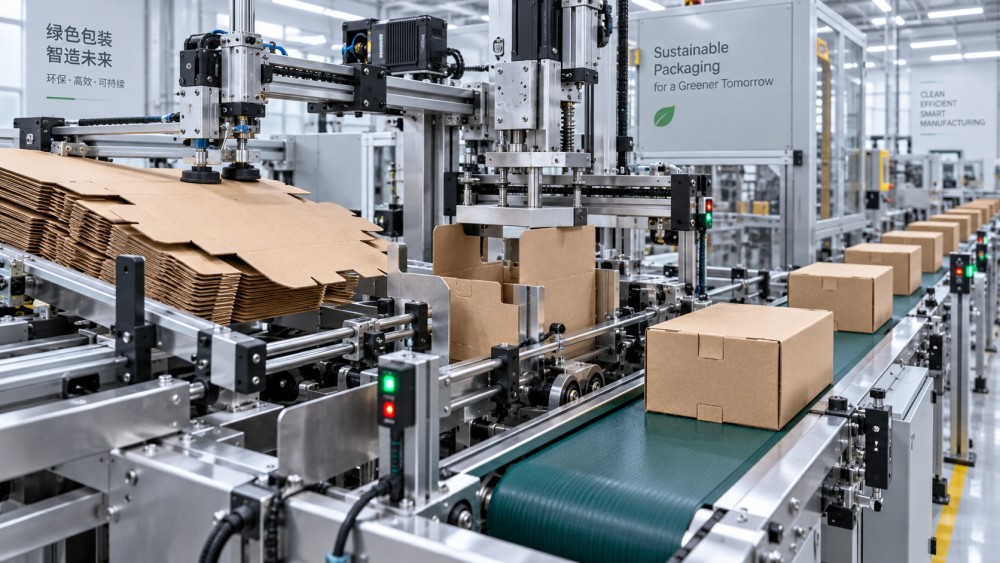
Buyers sometimes treat the packaging blank as a separate purchasing matter, but it directly affects equipment specification. Glue-free machines must interact accurately with creases, slots, locking tabs, and panel dimensions. Poorly controlled die-cutting can produce tabs that do not engage consistently, creases that resist folding, or blanks that skew in the feeder. The result may be lower throughput, extra sensing, more elaborate guides, or higher rejection handling requirements.
A package design that works in a hand-folded prototype is not automatically suitable for automated forming. For example, a lock may require a specific folding sequence to prevent the tab from catching. A narrow panel may need support while the final flap closes. A carton with a highly decorative coating may slide differently from uncoated board. These conditions can require dedicated tooling and more controlled transport.
Tooling is especially important where the package relies on mechanical locking. Custom folding rails, forming mandrels, plows, compression fixtures, and change parts may be needed for each carton family. A low base machine price can therefore be misleading if a buyer expects numerous formats but has not requested tooling costs by SKU.
Automation level changes labor cost and purchase cost in opposite directions
Glue-free packaging equipment can range from manually loaded forming aids to automated lines that feed blanks, erect packs, verify closures, reject defects, and transfer completed packs to downstream handling. The right level depends on production volume, labor availability, product variability, and tolerance for manual intervention.
Manual or semi-automatic systems usually have lower capital cost and may suit limited production runs, frequent design development, or products that are difficult to load automatically. Their hidden cost is operator dependency. When pack formation relies on correctly engaging tabs or aligning folds, inconsistent handling can increase rejects and slow the line during busy periods.
Automated systems add feeders, servo axes, sensors, PLC controls, safety guarding, reject systems, and often interfaces for conveyors or cartoners. These features raise the equipment price, but they can reduce repetitive manual work and make output more predictable. Automation is not automatically justified by sustainability goals; it is justified when the labor, quality, and throughput requirements support it.
A practical evaluation separates tasks that must be automated from tasks that may remain manual. For instance, blank feeding and closure verification may deserve automation because they directly affect pack integrity, while product insertion may remain manual for a variable product range. This avoids paying for a fully integrated line that is poorly matched to the actual workflow.
Integration costs are easy to underestimate
A glue-free forming unit rarely operates alone. It may receive die-cut blanks from a stack, accept products from a conveyor, work beside a digital print or coding station, and discharge packs to case packing or palletizing. Each interface can add cost through controls, physical transfer systems, buffering, guarding, communication protocols, and commissioning time.
The condition of upstream blanks deserves particular attention. If blanks are delivered with inconsistent stacking, curl, static charge, or variable moisture content, the equipment may require separation devices, air assistance, anti-static measures, or modified feeders. These additions are sometimes treated as optional accessories, even though they may be necessary for reliable production.
Downstream integration also affects the level of closure verification needed. A carton that enters automated case packing must retain its shape and remain properly locked. Buyers should decide whether vision inspection, mechanical presence checks, dimensional checks, or reject tracking are required. The cost of these systems should be compared with the consequence of poorly formed packs reaching distribution.
Define the handoff points in writing
Before requesting final pricing, map where responsibility starts and ends. Identify the blank presentation, product orientation, conveyor heights, available utilities, discharge accumulation, safety requirements, and data exchange expectations. This prevents a gap where the machine supplier assumes another party will provide transfer equipment, while the buyer assumes it is included.
The same discipline applies to installation. Freight, positioning, electrical work, compressed air, extraction where relevant, operator training, acceptance testing, and site commissioning can materially affect the project budget even though they are not part of the core machine price.
Energy and consumables may be lower, but operating costs do not disappear
Removing hot-melt or cold-glue application can eliminate adhesive purchasing, storage, heating, cleaning, and certain maintenance activities. That can simplify operations, particularly where glue stringing, nozzle blockage, adhesive temperature control, or curing behavior causes downtime. Yet glue-free equipment still consumes resources.
Mechanical locking may need compressed air, vacuum generation, servo motion, and occasional wear-part replacement. Heat or ultrasonic sealing introduces electrical demand and requires upkeep of heating or sonotrode-related components. Some pack styles require more board area, extra die-cut complexity, or tighter blank tolerances to achieve the required strength without adhesive. Those packaging material costs belong in the comparison.
Cost modeling should therefore compare the full packaging system rather than one eliminated consumable. Include board yield, blank conversion complexity, energy use, planned maintenance, cleaning time, expected tooling life, waste handling, and the labor required to manage materials. A glue-free format can still be commercially attractive, but the justification should be based on verified operating conditions rather than the assumption that “no glue” means “no ongoing cost.”
Maintenance and serviceability shape lifetime economics
Equipment with many moving guides, folding mechanisms, vacuum components, sensors, and adjustment points requires a realistic maintenance plan. The key procurement question is not whether maintenance exists, but whether routine tasks can be performed quickly and predictably by the available technical team.
Inspect access to wear points, adjustment scales, lubrication areas, sensor locations, and change parts. Ask which components are designed for routine replacement, which spares should be held locally, and whether diagnostic information identifies the source of common stoppages. A complex lock-forming machine may deliver strong pack consistency, but only if its setup can be restored accurately after cleaning, format change, or component replacement.
It is also useful to distinguish between normal adjustments and engineering interventions. Operators should be able to manage approved format settings and everyday checks. Requiring a specialist each time board caliper changes slightly can create avoidable downtime. On the other hand, unrestricted adjustment of critical forming geometry may lead to unstable locks and inconsistent quality.
Build the comparison around total cost of ownership
For a procurement decision, place each option in the same cost model. Start with the delivered machine, required tooling, installation, integration, and commissioning. Then estimate recurring expenditure under the intended production mix: labor, power, compressed air, packaging material, wear parts, scheduled service, unplanned downtime exposure, waste, and format-change time.
Do not use a single annual volume if demand is uncertain or product mix varies widely. Model at least the realistic operating pattern: typical run length, number of changeovers, board types, and expected manual tasks. This often reveals whether a less expensive semi-automatic machine is sufficient or whether a higher-capacity automated system prevents labor and bottleneck costs from accumulating.
Finally, make pack performance a commercial requirement. The finished package should be evaluated for closure security, dimensional stability, appearance, product protection, and compatibility with the next handling stage. The lowest glue-free packaging equipment cost is not necessarily the lowest machine quote; it is the option that can produce the required pack consistently without shifting cost into labor, waste, complex tooling, or downstream disruption.
Industry Briefing
Get the top 5 industry headlines delivered to your inbox every morning.
Recommended News