
Industrial Inkjet Systems for Packaging: Print Quality vs Throughput
For packaging buyers and business evaluators, industrial inkjet systems are no longer judged by speed alone. The smarter question is simple: how much sellable output can a system deliver without sacrificing color, barcode clarity, substrate range, or cost control?
That question matters more now because packaging runs are getting shorter, SKU counts are growing, and sustainability rules are tightening. In real production, the balance between print quality and throughput decides whether an investment supports growth or quietly creates waste.
At IPPS, this balance is viewed across the full paper-based value chain. Industrial digital printers, corrugated board lines, die-cutting systems, folder gluers, and converting lines all affect what an industrial inkjet system can truly achieve on the floor.
What Actually Defines Performance in Industrial Inkjet Systems
The first thing to remember is that headline speed rarely tells the whole story. A press rated for high output may slow down sharply when image coverage increases, darker colors are used, or coated and uncoated boards are mixed in one schedule.
That is why IPPS often tracks performance as a system issue, not a single-machine issue. Printhead behavior, drying, web or sheet stability, board flatness, and downstream converting readiness all shape practical throughput.
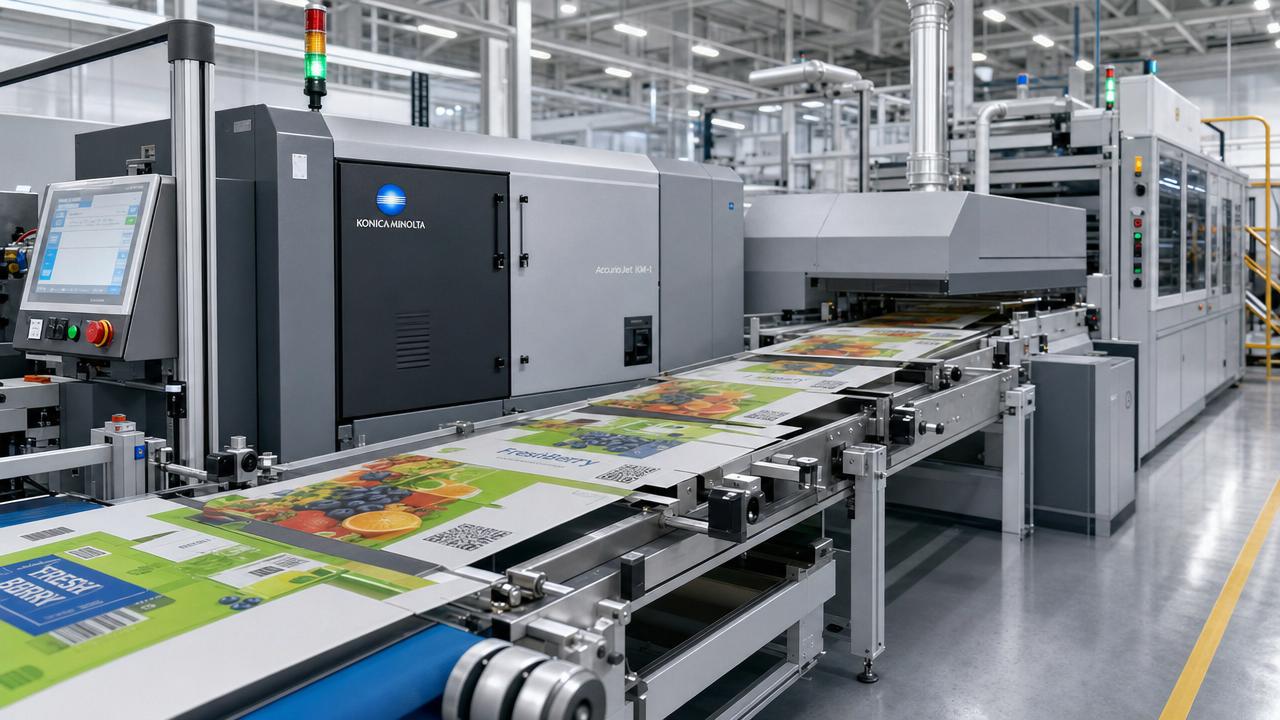
[Image 01: Industrial inkjet systems printing corrugated and folding carton samples on a packaging production line]
Key points worth checking first
- Check rated speed against real image coverage, not only vendor brochures. Industrial inkjet systems often show different throughput when solids, gradients, or variable data become part of daily production.
- Review native resolution together with drop size control. Fine text, brand colors, and retail-ready graphics depend on waveform tuning as much as on the printhead’s nominal dpi figure.
- Confirm substrate range with actual packaging grades. White-top liner, kraft, coated carton, and recycled board can react very differently to the same industrial inkjet systems and pretreatment settings.
- Measure sellable output, not mechanical output. A faster line loses value quickly if drying defects, cockling, mottle, or unreadable codes force rework or rejection downstream.
- Verify data handling capacity before approving speed claims. High-throughput industrial inkjet systems can bottleneck if RIP performance, file preparation, or inspection software cannot keep pace.
Where Print Quality Wins, Even When Throughput Looks Attractive
In packaging, quality is not just about aesthetics. It directly affects scan rates, shelf impact, compliance, and brand trust. A slightly softer logo might pass. A weak QR code or unstable black density often does not.
This is especially true when industrial inkjet systems are used for versioned packaging, promotional runs, or e-commerce-ready boxes that must combine visual appeal with machine readability.
Areas where quality should carry more weight
- Prioritize edge sharpness for small text and legal copy. In folding cartons and labels-on-box workflows, fuzzy character edges can create compliance risk long before operators notice obvious defects.
- Check barcode and QR readability at production speed. Some industrial inkjet systems pass lab samples but lose consistency once heat load, board variation, and line acceleration enter live operation.
- Review color consistency across shifts and substrates. Stable reproduction matters when one campaign spans corrugated outers, promotional inserts, and retail packaging produced at different times.
- Inspect ink holdout on recycled papers. Sustainable packaging grades may support ESG goals, but poor surface control can reduce image density and reveal limits in inkjet fluid management.
- Test rub resistance after printing and converting. Good-looking graphics lose value if they scuff during die-cutting, folding, gluing, transport, or warehouse handling.
Where Throughput Deserves More Attention
Not every application needs premium graphics. For transit packaging, secondary packs, or high-volume brown box programs, steady output and uptime may matter more than photographic detail.
Still, faster is only better when the rest of the line can absorb the pace. IPPS regularly sees investment cases where the printer is upgraded, but corrugated feeding, drying, inspection, or folder gluer synchronization remains the real limit.
Questions that reveal true throughput value
- Compare printer speed with finishing capacity. If die-cutting, stacking, or folding-gluing runs slower, the throughput advantage of industrial inkjet systems may stay mostly theoretical.
- Track uptime by shift, not by demo sample. Cleaning cycles, nozzle recovery, substrate adjustments, and file changes often separate practical output from advertised line speed.
- Evaluate makeready time for job changes. Industrial inkjet systems gain real value when frequent design variation can be handled without long stops or repeated color corrections.
- Assess drying margin under peak volume. A press can look productive until humidity, heavy coverage, or denser boards force speed reduction to avoid setoff and post-press trouble.
- Check operator dependency during high-speed runs. Systems that need constant manual tuning may struggle to maintain claimed throughput across mixed packaging schedules.
A Practical Comparison Table for Business Evaluation
A useful review framework is to compare industrial inkjet systems by business impact rather than isolated technical specifications. The table below keeps the discussion grounded in operational results.
Typical Packaging Scenarios and What Changes
Corrugated e-commerce boxes
For corrugated applications, board profile and surface variation matter as much as printhead quality. Ink spread, flute show-through, and drying consistency can shift quickly between white-top and brown kraft substrates.
In this setting, industrial inkjet systems should be checked together with corrugated board stability, feeder control, and downstream stacking. IPPS often treats web tension, sheet flatness, and converting rhythm as part of the same buying decision.
Folding carton and promotional packaging
Here, visual quality usually rises in importance. Fine typography, premium color appearance, and surface durability matter because the package works as both a container and a marketing surface.
It is smart to test industrial inkjet systems through die-cutting and folding-gluing, not just at the print section. Cracking, scuffing, or glue-area contamination can erase quality gains made at the press.
Common Gaps That Distort Buying Decisions
One common mistake is to compare industrial inkjet systems using only peak speed and purchase price. That leaves out waste, ink consumption, spare parts, maintenance intervals, and reject rates after finishing.
Another gap appears when test files are too easy. Light coverage and ideal boards can hide weaknesses that show up later on recycled liners, dense solids, versioned graphics, or mixed-shift operation.
- Ask for production-condition trials, not cosmetic demos. Real board grades, realistic job queues, and downstream converting checks reveal whether industrial inkjet systems fit operational targets.
- Include maintenance logic in the evaluation. Nozzle health routines, printhead replacement policy, and cleaning chemistry can materially change total cost over the equipment lifecycle.
- Validate sustainability claims with evidence. Lower waste, reduced setup materials, and compatibility with certified paper stocks often matter more than broad environmental marketing language.
- Review integration with digital planning tools. The best industrial inkjet systems create more value when linked to order data, inspection records, and fast version control.
How IPPS Frames the Best Next Step
A strong decision starts by defining the dominant business need. Is the real priority premium graphics, fast version changes, brown-box efficiency, lower waste, or better fit with sustainable paper packaging trends?
From there, industrial inkjet systems should be evaluated as part of a broader production ecosystem. That means connecting inkjet quality, corrugated behavior, post-press reliability, and digital workflow readiness in one review path.
IPPS follows this wider lens because modern packaging performance is no longer created by one machine alone. It is built through the coordination of print science, board forming, finishing precision, and sustainable operating logic.
If the next comparison stays focused on sellable output, substrate reality, and downstream fit, the choice becomes clearer. The right industrial inkjet systems are not simply the fastest. They are the ones that keep quality, throughput, and packaging economics working in the same direction.
Industry Briefing
Get the top 5 industry headlines delivered to your inbox every morning.
Recommended News