
PPWR first day of enforcement: Color-printed packaging bags blocked from entering Europe

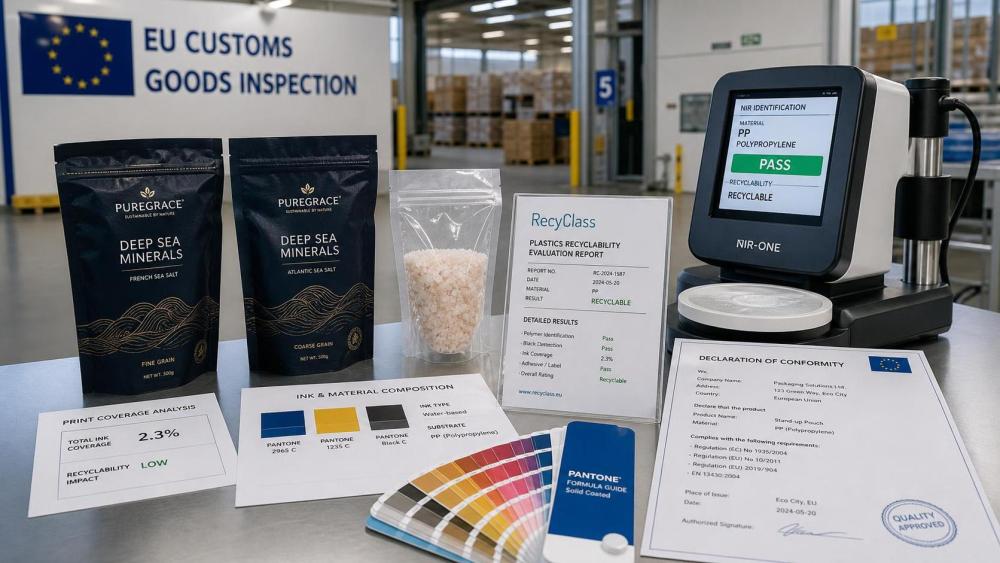
On August 12, 2026, PPWR issued a customs clearance and enforcement signal on the first day it came into effect. After the Dutch and German customs jointly issued the first batch of warnings, exports related to color printed packaging bags began to directly face simultaneous reviews of NIR recognizability, ink migration and recyclability ratings, involving common categories such as e-commerce color boxes, bone bags and instruction bags. This change deserves attention not only because of the goods deduction itself, but because it puts the printing process, material selection, inspection documents and delivery conditions into Europe on the same compliance chain.
What signal did the first batch of customs clearance warnings release?
According to confirmed information, on August 12, 2026, the first day when the PPWR regulations came into effect, the Dutch and German customs jointly issued the first batch of customs clearance warnings: more than 17 batches of color-printed packaging bags were immediately detained for reasons including dark full-page printing of more than 30%, failure to use NIR detectable carbon black, and excessive migration of water-based ink, which ultimately led to the RecyClass recyclability rating being lower than C, that is, lower than 70%. Relevant goods are required to submit DoC and RecyClass inspection reports within 48 hours. ZXTAG 10 Z Judging from this round of notifications themselves, supervision no longer only looks at the name of the material, but has begun to put printing coverage, pigment selection and third-party testing documents into the same set of customs clearance judgments.
Which links will feel the pressure first
Export delivery link
Direct trade companies and export companies will be the first to feel the changes. In the past, packaging bags were more focused on order delivery and appearance confirmation. Under such notifications, DoC, RecyClass test reports and traceability information need to be prepared simultaneously. For orders that have been scheduled, are in transit, or are about to be shipped, document gaps are more likely to amplify customs clearance risks than cosmetic defects.
Processing and printing links
For users of Flatbed Die-cutters, Web-fed Stamping Mach and Digital Packaging Presses, the risk mainly lies in the plate making, print coverage and ink selection stages. Dark full-page printing, no use of NIR detectable carbon black, and water-based ink migration control will directly affect whether the final packaging meets the European requirements. In other words, process parameters are no longer just a matter of finished product performance, but also a matter of compliance.
Procurement and certification links
Raw material procurement companies, certification-related companies and testing service institutions will also be affected. The purchasing side needs to confirm earlier whether the ink, substrate and auxiliary materials support NIR identification and corresponding testing requirements; the certification and testing side need to form a more complete document chain around RecyClass rating and DoC. For purchasers, whether suppliers can provide verifiable reports in a timely manner may directly affect whether to place an order and accept delivery.
What details should enterprises pay more attention to now
Complete the document chain first
The most direct meaning of this kind of law enforcement information is that document preparation has entered the preparatory stage. Enterprises need to at least confirm whether the DoC, RecyClass test reports and related technical information can be quickly retrieved within a time limit of 48 hours, and correspond one-to-one with the actual shipment batches. For export business, documents are not ancillary materials, but part of the customs clearance conditions.
Recheck the process and materials
From this report, dark full-page printing, NIR detectable carbon black and water-based ink migration are clearly mentioned risk points. Enterprises need to go back and check whether the current products still use the same solution, especially orders for the EU market. If the product itself is a high-coverage printing design, the procurement and production links must confirm in advance whether its recyclability rating and test results can support shipments.
Leave a buffer in the delivery cycle
For export projects that rely on tight delivery times, the 48-hour certification requirement means that internal approvals, testing and customer communications cannot be arranged according to the traditional rhythm. A more appropriate approach at present is to move compliance verification to the order placing and production scheduling stage, rather than waiting for the goods to arrive at the port.
Pay attention to whether the follow-up standards will continue to be tightened
This notification only stated that the first batch of enforcement has occurred, but did not give a more complete follow-up enforcement boundary. For market participants, what is more worthy of attention next is whether the official further refines the enforcement standards for printing coverage, NIR identification materials, migration indicators and rating thresholds.
This is more like a taking effect signal, rather than an isolated case
From the analysis, this information is more suitable to be understood as an execution signal after the taking effect of PPWR, rather than a single clearance anomaly. The reason is that the notification also focuses on three levels: material identification, recyclability rating and document submission, indicating that regulatory judgment is moving closer to "whether the product can prove compliance", rather than just whether the goods have been produced.
From observation, what the industry needs to continue to track in the future is not only whether customs will continue to withhold goods, but also whether the use of RecyClass testing and DoC in actual trade tends to be fixed, and whether different market participants will translate this set of requirements into procurement terms, bidding conditions or delivery acceptance standards.
How to understand the industry implications of this information
It is more suitable to regard this first-day enforcement as a clear compliance reminder: Color-printed packaging bags exported to the EU can no longer be prepared based only on appearance, size and conventional quality standards. NIR identification, ink migration, recycling rating and document integrity are all together forming a new customs clearance threshold. For relevant companies, the most practical judgment at present is not "whether the impact will expand", but to first confirm whether their products, supply chain and evidence chain can pass such inspections.
Public clues on which this article is based
This article is generated based on the information title, event time and event summary provided by the user, and does not introduce unverified external facts. Types of sources typically associated with such events include official announcements, regulatory agency releases, customs or trade authority information, industry association information, standards organization documents and authoritative media reports. Since no specific official source link is provided in the input, this article will not supplement the link. It is still necessary to continue to verify the PPWR enforcement details, certification standards, changes in bidding documents, industry feedback, and actual enforcement status of the company.
Industry Briefing
Get the top 5 industry headlines delivered to your inbox every morning.
Recommended News