
How Precision Actuator Systems Improve Motion Accuracy
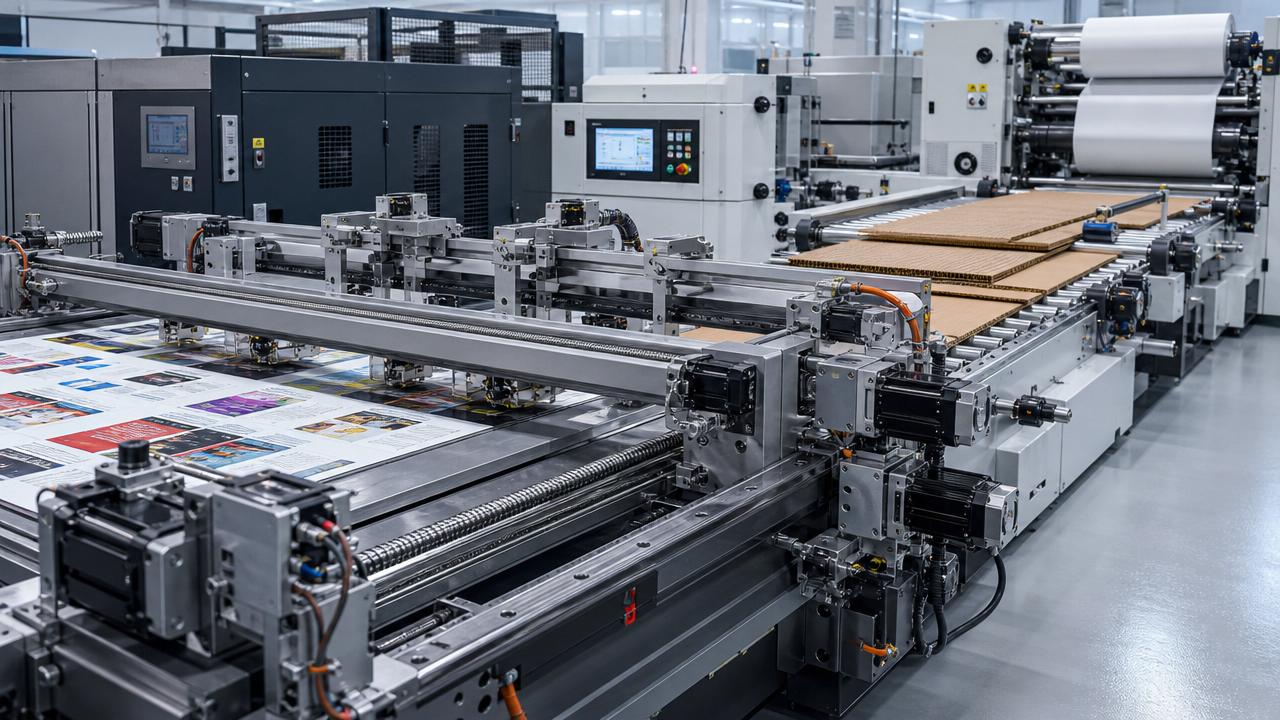
In printing and paper converting, motion accuracy is rarely a narrow control issue. It shapes print registration, board alignment, fold quality, glue placement, rewinding stability, and machine uptime. That is why Precision Actuator Systems matter so much. They help machines react faster, position more exactly, and hold consistency under speed, load variation, and continuous production pressure.
For operations linked to digital printing, corrugated production, die-cutting, folder gluing, and tissue processing, small motion errors can become visible defects or hidden waste. In this context, Precision Actuator Systems are not just components. They are part of the control foundation behind higher throughput, tighter tolerances, and more reliable automation decisions.
Why motion accuracy has become a strategic issue
Across the IPPS landscape, production lines are moving toward faster changeovers, shorter runs, lower waste, and stronger traceability. At the same time, packaging quality expectations keep rising.
A high-speed inkjet platform needs stable carriage motion and repeatable substrate transport. A corrugated line depends on disciplined tension and synchronized section movement. Post-press machines need exact timing between feeding, cutting, creasing, folding, and bonding.
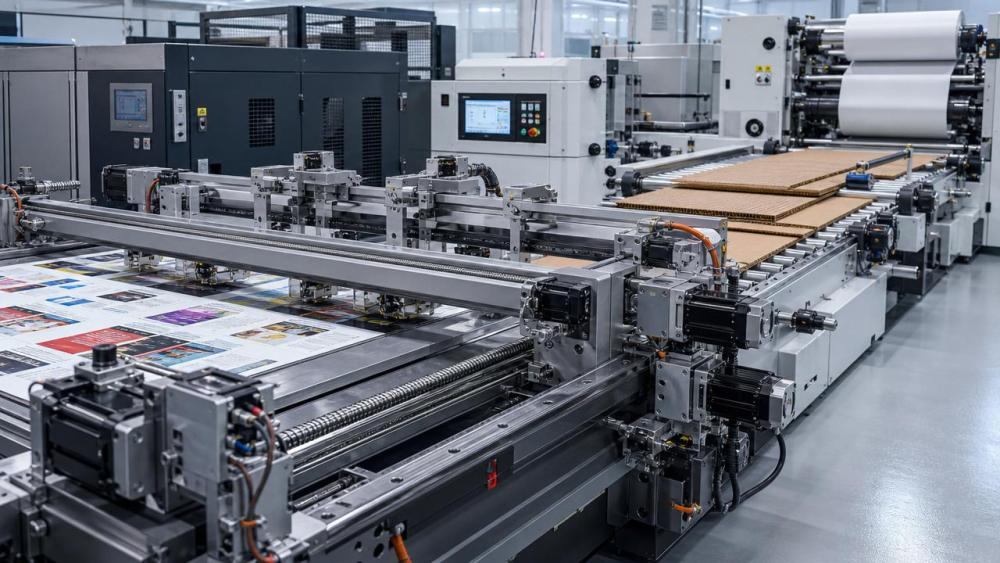
When sustainability targets and e-commerce packaging volumes rise together, the cost of poor motion control becomes easier to measure. It appears in scrap, rework, slower speeds, unstable quality windows, and premature mechanical wear.
This is also why IPPS tracks not only machinery trends, but the control logic behind them. Precision Actuator Systems sit directly at that intersection of mechanical execution and digital intelligence.
What Precision Actuator Systems actually improve
At a practical level, Precision Actuator Systems convert control commands into highly controlled motion. That sounds simple, but the quality of that conversion determines whether the machine hits the commanded position, speed, force, and timing window.
The improvement usually comes from several linked capabilities rather than one feature alone.
Tighter positioning
Higher-resolution feedback and better servo behavior reduce deviation between target and actual position. In print engines, that supports registration control. In die-cutting, it supports repeatable tool engagement.
Faster response to disturbances
Material changes, line acceleration, vibration, and load shifts happen constantly. Precision Actuator Systems can correct faster, limiting overshoot and reducing the time needed to settle.
Better synchronization between axes
Many critical processes involve coordinated motion. Feeding, printing, cutting, folding, and rewinding all depend on axis relationships, not just single-axis accuracy.
More stable force and tension behavior
In web handling and converting, accurate force control can matter as much as position control. Stable actuator performance helps maintain tension bands that protect both quality and substrate integrity.
Where the gains show up in print and paper systems
The value of Precision Actuator Systems becomes clearer when viewed through actual machine behavior rather than generic automation claims.
In other words, motion accuracy is not an isolated engineering metric. It travels directly into product appearance, machine efficiency, and supply chain reliability.
Why better actuation matters beyond speed
A common mistake is to judge actuator upgrades mainly by top-line speed. In practice, the broader value often appears in the stability of the full operating window.
Precision Actuator Systems help lines stay closer to target performance across changing conditions. That includes substrate variation, thermal drift, tool wear, and mixed-order production.
This matters especially in sectors influenced by customized packaging and paper-based sustainability initiatives. Shorter runs and more frequent job switches leave less room for manual correction.
More accurate motion also supports digitalization goals. Better data is useful only when the machine can execute commands predictably. Precision Actuator Systems close that gap between software intelligence and physical output.
What to evaluate when comparing Precision Actuator Systems
Evaluation should go beyond catalog precision claims. A strong system performs in context, inside the actual dynamics of the machine.
- Response bandwidth: how quickly the system reacts to speed changes, load disturbances, and command updates.
- Repeatability under production conditions: whether accuracy remains stable during long runs, heat buildup, and frequent cycle changes.
- Feedback quality: encoder resolution, signal integrity, and resistance to contamination or vibration.
- Mechanical integration: coupling stiffness, backlash control, mounting rigidity, and alignment discipline.
- Control compatibility: how well the actuator system works with existing PLC, servo, HMI, and diagnostic layers.
- Lifecycle factors: maintenance demand, spare parts availability, calibration needs, and expected performance drift.
Usually, the best choice is not the most extreme specification. It is the option that keeps precision, responsiveness, and maintainability in balance.
Common accuracy limits that are not caused by the actuator alone
Precision Actuator Systems can significantly improve motion accuracy, but they do not erase weak system design. If results fall short, the root cause may sit elsewhere.
Structural vibration and compliance
A high-performance actuator mounted on a flexible structure will still inherit instability. Machine frame dynamics must be part of the review.
Poor tension architecture
In web processes, control quality suffers when dancers, rollers, brakes, and driven zones are not coordinated. Actuation helps, but architecture decides the limit.
Inadequate sensing strategy
If the system measures the wrong variable or measures too late, accuracy improvements remain partial. Motion control quality depends on what the system can truly observe.
Control tuning that ignores process behavior
A tuned axis in idle mode may behave differently with live material, actual temperature, and real acceleration patterns. Commissioning must reflect the production envelope.
How to apply this understanding in real projects
A useful approach starts with identifying where motion error creates business loss. That may be print defects, unstable folding, glue misses, board tracking problems, or rewind inconsistency.
Then map each issue to a motion layer. Is it axis response, multi-axis synchronization, tension control, mechanical play, or sensing latency? This prevents expensive upgrades that treat symptoms only.
IPPS-style evaluation is especially relevant here. Machine decisions become stronger when motion data is read together with substrate behavior, production economics, and evolving packaging requirements.
For example, a line serving fast-turn e-commerce packaging may prioritize agile synchronization and short settling time. A premium finishing line may place more weight on repeatable registration and force stability.
That distinction matters because Precision Actuator Systems should be selected around process priorities, not as generic high-end hardware.
A practical next step for evaluation
The strongest evaluation usually begins with a narrow set of measurable questions. Which defect modes are motion-related? Where does error accumulate? How often does the machine leave its optimal quality window?
From there, compare Precision Actuator Systems against actual process demands: accuracy at speed, recovery after disturbance, synchronization quality, diagnostics depth, and maintainability over time.
In sectors shaped by digitalization, green packaging, and higher customization, motion accuracy is becoming a competitive capability rather than a background specification. A structured review now can clarify whether the next gain should come from actuation, sensing, mechanics, or full control architecture refinement.
Industry Briefing
Get the top 5 industry headlines delivered to your inbox every morning.
Recommended News