
Industrial Microwave Technology: Key Efficiency Gains and Process Limits
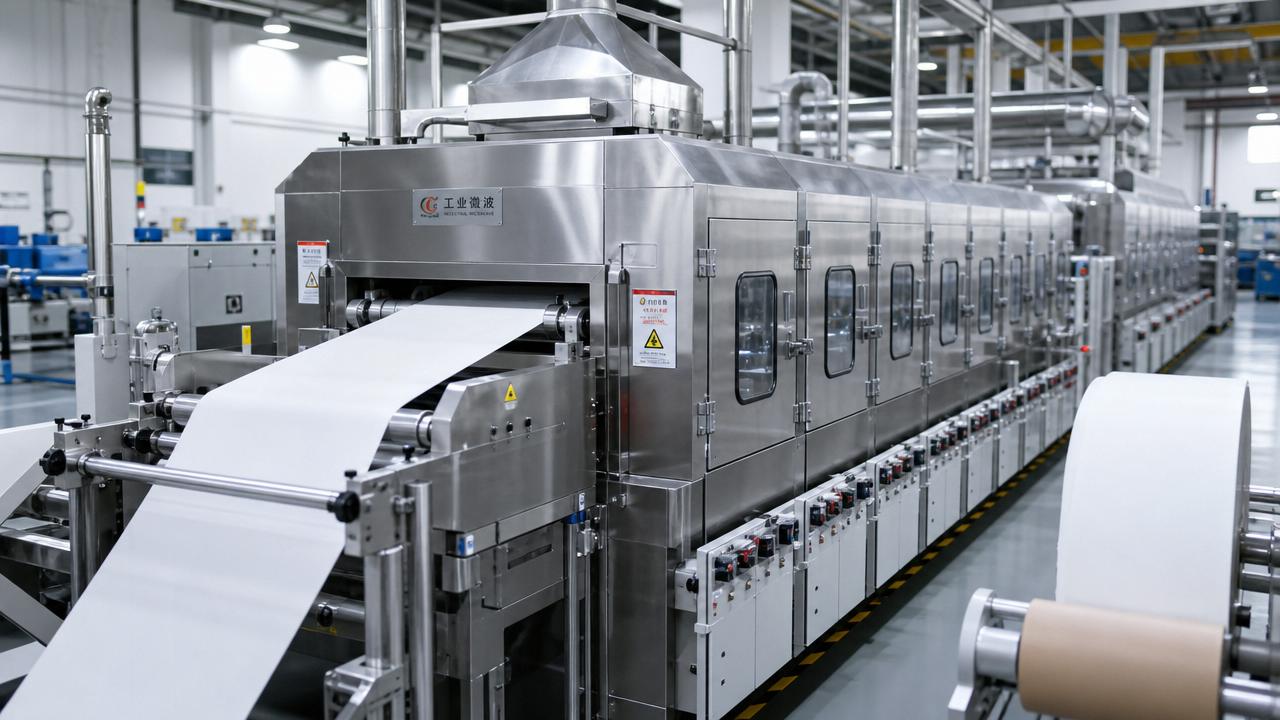
Industrial Microwave Technology is gaining practical attention because it changes how heat is delivered, not just how fast a line runs. In sectors where moisture, coatings, adhesives, fibers, and layered substrates must be controlled precisely, that difference matters.
For operations tied to print, paper, packaging, and converting, heating is rarely an isolated utility step. It affects web stability, bond strength, drying windows, energy cost, and final product consistency. That is why Industrial Microwave Technology is now being evaluated less as a novelty and more as a process tool with clear boundaries.
The opportunity is real, but so are the limits. Faster volumetric heating can improve output and reduce thermal exposure, yet uneven field distribution, material variability, and integration complexity can reduce the expected gain if the application is poorly matched.
Why microwave processing matters now
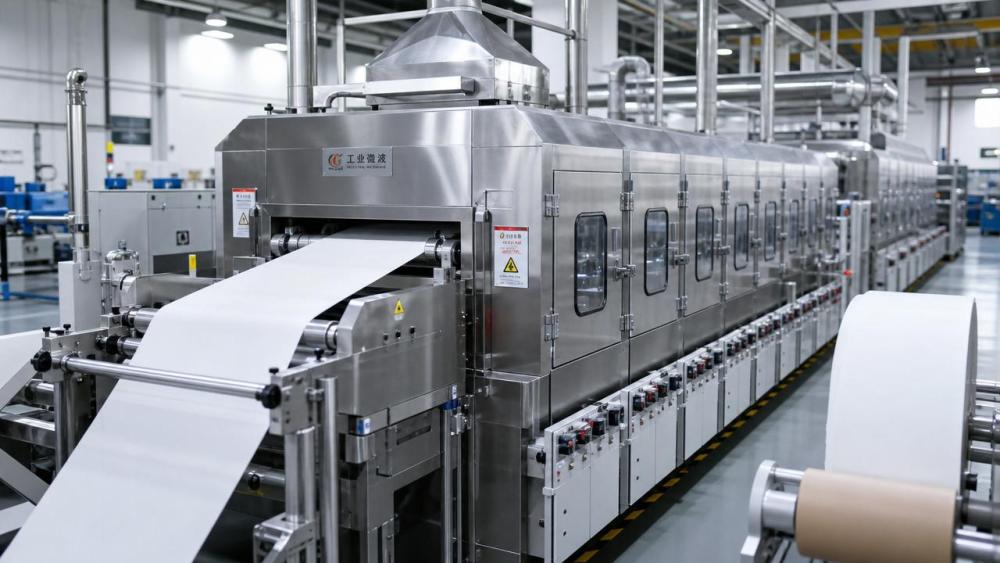
A useful image here is a continuous line where heating speed influences every downstream step.
Traditional heating methods usually transfer energy from the surface inward. Industrial Microwave Technology works differently. Electromagnetic energy interacts with polar molecules, especially water, and generates heat inside the material volume.
That mechanism can shorten cycle time, reduce warm-up delays, and improve responsiveness during recipe changes. In high-mix production, those benefits are often more valuable than headline power savings alone.
The timing also fits broader industry pressures. Packaging lines are being asked to run lighter materials, more variable job sizes, and tighter sustainability targets. IPPS tracks these shifts closely across digital printing, corrugation, post-press, folder gluing, and tissue converting.
In that environment, any heating technology must support throughput, material efficiency, and stable quality at the same time. Industrial Microwave Technology becomes relevant because it can influence all three, but only in the right thermal window.
What Industrial Microwave Technology actually changes
The core advantage is selective and rapid energy coupling. Materials with moisture or dielectric loss absorb microwave energy more readily than dry, inert, or highly reflective components. This means the process response depends heavily on composition.
In practice, Industrial Microwave Technology can do several things well:
- Accelerate moisture removal from porous or hygroscopic materials.
- Reduce surface overheating during internal heating tasks.
- Improve start-stop flexibility compared with large thermal masses.
- Support tighter process control in shorter dwell zones.
- Lower total exposure time for heat-sensitive layers.
These strengths explain why microwave systems are often considered for drying, preheating, curing support, moisture equalization, pasteurization, and specialty bonding processes. However, they do not replace every oven, steam section, or infrared stage.
More importantly, performance must be measured at process level. A faster heating event is useful only if it preserves product shape, coating behavior, adhesive function, and downstream handling.
Where efficiency gains are most credible
The strongest cases usually involve moisture-rich, nonmetallic, or porous materials with significant internal diffusion limits. That includes many web-based and paper-related operations where conventional heating spends time driving heat through thickness before evaporation becomes efficient.
In paper and packaging contexts, Industrial Microwave Technology may support:
- Moisture conditioning before converting or laminating.
- Targeted drying after water-based coating or printing stages.
- Adhesive activation support in complex multilayer assemblies.
- Uniformity correction in tissue or specialty paper treatment.
- Intermediate heating where line length is constrained.
For corrugated and post-press applications, the value is rarely just speed. It may be the ability to stabilize moisture profiles, reduce curl risk, or shorten the distance between process stages in crowded layouts.
For digital print environments, especially where coatings, primers, or variable substrate mixes are present, the attraction is process agility. Shorter thermal lag can make changeovers easier and reduce the penalty of smaller production lots.
Typical gain mechanisms
The process limits that decide real-world value
Industrial Microwave Technology is not automatically more uniform or more efficient in every case. The biggest mistake is to evaluate it by theoretical heating speed without checking how the product interacts with the electromagnetic field.
Several constraints usually define the true business case:
- Material variability can shift absorption and create unstable outcomes.
- Complex geometry can produce hot spots or cold zones.
- Metals, foils, and dense assemblies can limit applicability.
- Capital cost may be difficult to justify at low utilization.
- Shielding, safety, and maintenance add integration demands.
Thermal uniformity deserves special attention. In web and sheet processes, uneven moisture content, edge effects, and thickness variation can create inconsistent heating. That may appear acceptable during trials, then become problematic at production speed.
Another limit is that microwave heating often works best as part of a hybrid architecture. Pairing it with hot air, infrared, or steam may deliver better stability than asking one technology to complete the entire thermal task.
How to assess fit in print, paper, and packaging lines
Within the IPPS lens, the most relevant question is not whether Industrial Microwave Technology is advanced. The real question is whether it improves yield, throughput, and controllability across the line segment that matters most.
A practical assessment usually starts with four variables: substrate behavior, target moisture or temperature profile, line speed, and downstream sensitivity. If any one of those is unclear, projected gains tend to be overstated.
For example, a corrugated operation may care less about peak temperature and more about board flatness after moisture adjustment. A digital print line may focus on coating integrity, ink interaction, and registration stability. A tissue process may prioritize uniformity and hygiene-focused throughput.
This is where data discipline matters. IPPS often highlights how process intelligence, not equipment headlines, separates successful adoption from disappointing retrofits. Microwave evaluation should include energy balance, defect rate, moisture mapping, and line interaction analysis.
Questions that improve evaluation quality
- Is the bottleneck truly heating, or is it handling, tension, or curing time?
- Does the material show stable dielectric behavior across seasons and suppliers?
- Can the process tolerate small thermal nonuniformities?
- Will hybrid heating outperform a full microwave conversion?
- How will maintenance, shielding, and operator training affect uptime?
Decision signals worth tracking next
Industrial Microwave Technology is most convincing when it is tied to a measurable production problem. Good examples include excessive line length for drying, moisture-related defects, heat damage from surface-first methods, or poor responsiveness during frequent product changeovers.
It is less convincing when the application depends on uniform heating across reflective components, when throughput is too low to recover capital, or when a standard thermal upgrade would solve the same issue with less integration risk.
A useful next step is to build a narrow evaluation framework rather than a broad technology narrative. Define the material set, the failure modes, the acceptable quality window, and the economic threshold. Then compare standalone microwave, hybrid heating, and conventional alternatives on the same basis.
That approach keeps Industrial Microwave Technology in the right context: not as a universal answer, but as a high-potential process option whose value depends on fit, control, and line-level outcomes. For organizations following the smarter, lower-carbon direction mapped by IPPS, that is the most reliable way to judge where microwave processing deserves a serious place in the roadmap.
Industry Briefing
Get the top 5 industry headlines delivered to your inbox every morning.
Recommended News