
Specialized Sealing: How to Reduce Leakage Risk in Harsh Applications
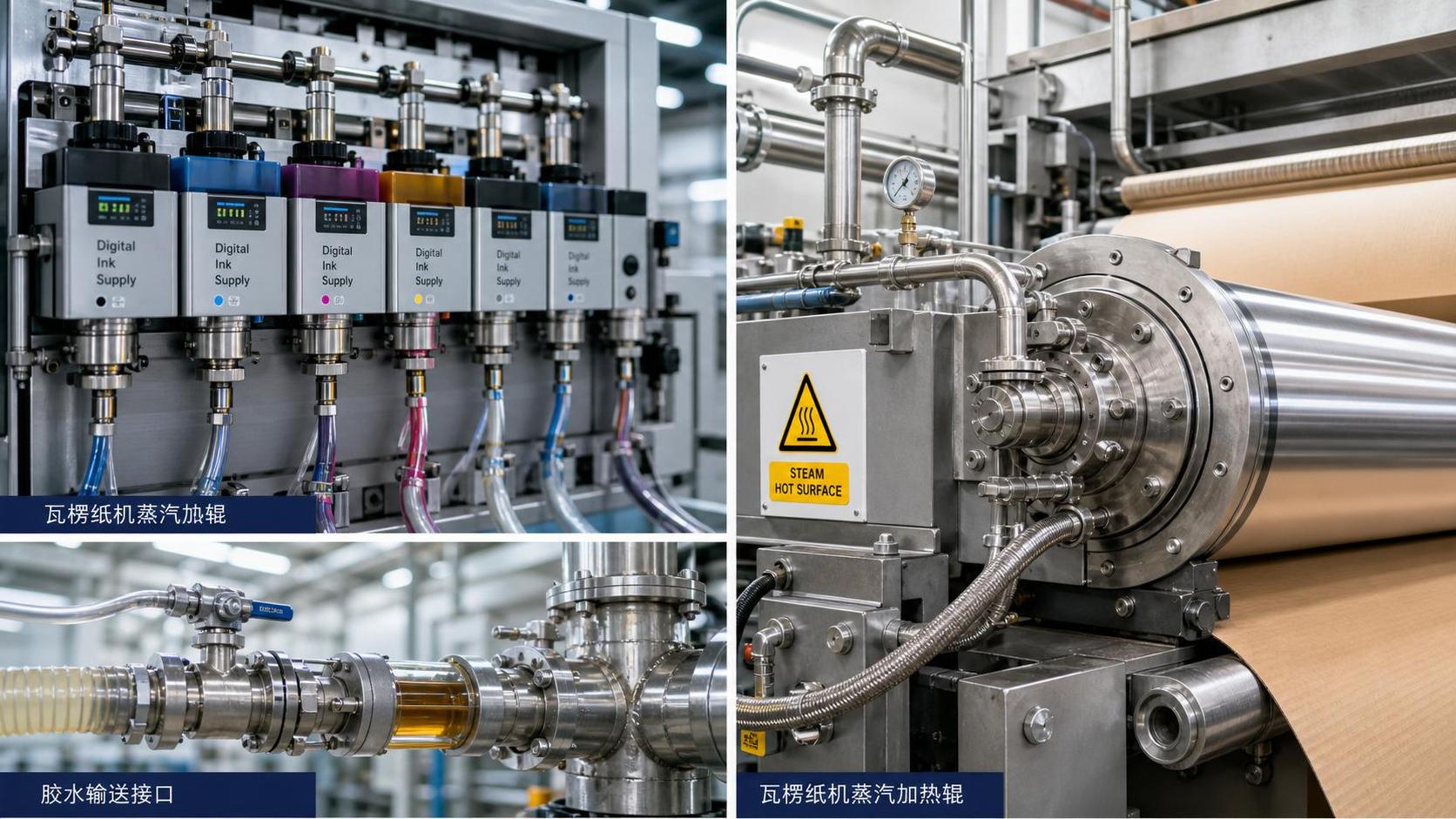
Why leakage risk changes from one harsh application to another
In paper-based manufacturing, leakage rarely stays a minor maintenance detail for long.
A small seal failure can stain printed surfaces, destabilize web handling, contaminate glue circuits, or interrupt steam and vacuum performance.
That is why Specialized Sealing matters across the systems tracked by IPPS.
From digital printers to corrugated lines, from die-cutting to tissue converting, operating stress looks similar from a distance.
In practice, the failure mechanisms are different.
Some lines face heat cycling and steam ingress.
Others deal with ink chemistry, washdown fluids, adhesive buildup, fiber dust, or constant vibration at high speed.
A sealing choice that performs well on a dry bearing zone may fail quickly inside a hot glue manifold.
A compact seal that survives static pressure may still lose integrity under shaft runout, pulsing pressure, or repeated stop-start cycles.
The more advanced the equipment, the narrower the tolerance for leakage becomes.
High-resolution printing, premium post-press finishing, and hygienic tissue production all depend on stable, clean process conditions.
Specialized Sealing is therefore less about one universal material and more about matching seal behavior to a real operating envelope.
Digital printing lines need sealing that protects precision, not just pressure
In industrial digital printers, leakage risk often appears first in places where precision is least forgiving.
Ink delivery circuits, recirculation loops, printhead interfaces, and cleaning modules all combine chemistry with tight dimensional control.
Here, Specialized Sealing must resist swelling, extractables, and micro-leakage.
Even a slight incompatibility can alter droplet formation, nozzle stability, or color consistency on corrugated and specialty substrates.
More common problems come from assuming all inks create the same sealing demand.
Water-based, UV-curable, pigment-loaded, and cleaning solvent environments behave very differently over time.
The better evaluation method is to check chemical compatibility together with temperature peaks, purge frequency, and shutdown duration.
If the line supports short runs and frequent changeovers, sealing stability during repeated exposure transitions becomes critical.
Corrugated board production puts Specialized Sealing under heat, steam, and tension shock
Corrugated board lines create a very different sealing environment.
Steam systems, heated rolls, starch handling, dust, and long machine frames generate combined thermal and mechanical stress.
In this setting, Specialized Sealing must cope with expansion mismatch, condensate exposure, and continuous vibration.
The key issue is rarely pressure alone.
It is pressure combined with cycling.
When steam sections ramp up and down, seals are asked to hold shape during repeated thermal movement.
When web tension fluctuates, connected rotating elements can introduce misalignment and shaft motion that static seal ratings do not reveal.
This is also where long-term cost judgment changes.
A low-cost seal with frequent replacement can create more downtime than its price ever suggests.
For corrugators running to meet e-commerce packaging demand, uptime loss often matters more than unit seal cost.
What usually matters most across the main equipment zones
Different paper and packaging machines do not evaluate Specialized Sealing in the same way.
A practical comparison helps separate visible symptoms from actual sealing priorities.
Post-press and gluing stations demand sealing that survives contamination and speed
Die-cutting, stamping, and folder gluer systems bring another set of sealing pressures.
The challenge here is often mixed exposure rather than one extreme medium.
Hydraulic motion, lubrication, hot or cold glue, paper dust, and frequent starts and stops can all interact.
Specialized Sealing in these machines needs to handle dynamic motion without becoming difficult to clean or replace.
In high-speed box converting, small leaks often go unnoticed until they affect fold accuracy, glue pattern control, or downstream product appearance.
That makes accessibility part of sealing strategy.
If a seal sits in a contamination-prone area, easier inspection and faster replacement may reduce risk more effectively than a theoretically higher-rated material.
This is one reason IPPS often tracks not only machine performance, but also maintainability and life-cycle stability.
Tissue machinery raises a cleaner, faster, and more sensitive sealing question
Tissue processing equipment tends to expose a different weakness in sealing decisions.
A seal may appear mechanically adequate, yet still be unsuitable for hygiene-sensitive production.
Specialized Sealing in rewinders, embossing units, and packaging modules should limit particle release, tolerate humidity, and remain stable under continuous high-speed operation.
Washdown routines also change the judgment criteria.
Repeated cleaning can shorten seal life if material selection only considers process media and ignores sanitation chemicals.
In actual use, cleaner production is not only about sterile zones.
It is also about preventing tiny leaks from attracting dust, softening adhesives, or creating hidden residue around guarding and transfer points.
Where sealing decisions are often misjudged
Several leakage problems repeat across industries because the early judgment was too narrow.
- Choosing by temperature and pressure only, while ignoring motion, vibration, and misalignment.
- Treating similar paper machines as identical, even when media, cleaning methods, and duty cycles differ.
- Comparing purchase price without measuring downtime exposure, replacement labor, and product loss.
- Using a chemically resistant seal that becomes too stiff for repeated cycling or low-temperature startup.
- Ignoring installation quality, housing finish, and shaft condition, then blaming only the seal material.
These misjudgments explain why Specialized Sealing should be treated as a system decision.
Material choice matters, but interface geometry, operating rhythm, contamination control, and maintenance access matter just as much.
A practical way to match Specialized Sealing to the real operating envelope
A workable sealing review usually starts with the process, not the catalog.
The most useful questions are direct and site-specific.
- Which medium is actually leaking, and does its chemistry change during startup, cleaning, or shutdown?
- Is the seal static, reciprocating, or rotating under real production conditions?
- How much thermal cycling occurs during a normal week, not just at rated conditions?
- What contamination enters from paper dust, starch, adhesive residue, or washdown spray?
- How difficult is inspection, and what does replacement interrupt upstream or downstream?
For IPPS-related equipment, this approach aligns well with broader smart manufacturing goals.
Better Specialized Sealing supports cleaner process control, lower waste, and steadier production efficiency.
It also fits the industry direction toward digitalized uptime management, sustainable packaging, and lower unplanned intervention.
The next step is not to assume one best seal for every machine.
It is to map each leakage point by medium, motion, temperature range, contamination load, and maintenance window.
Once those conditions are clear, Specialized Sealing becomes easier to evaluate on performance, service life, and implementation risk.
That is usually where leakage reduction stops being reactive and starts supporting more stable production across printing and paper systems.
Industry Briefing
Get the top 5 industry headlines delivered to your inbox every morning.
Recommended News