
How much does packaging automation cost beyond the equipment price?
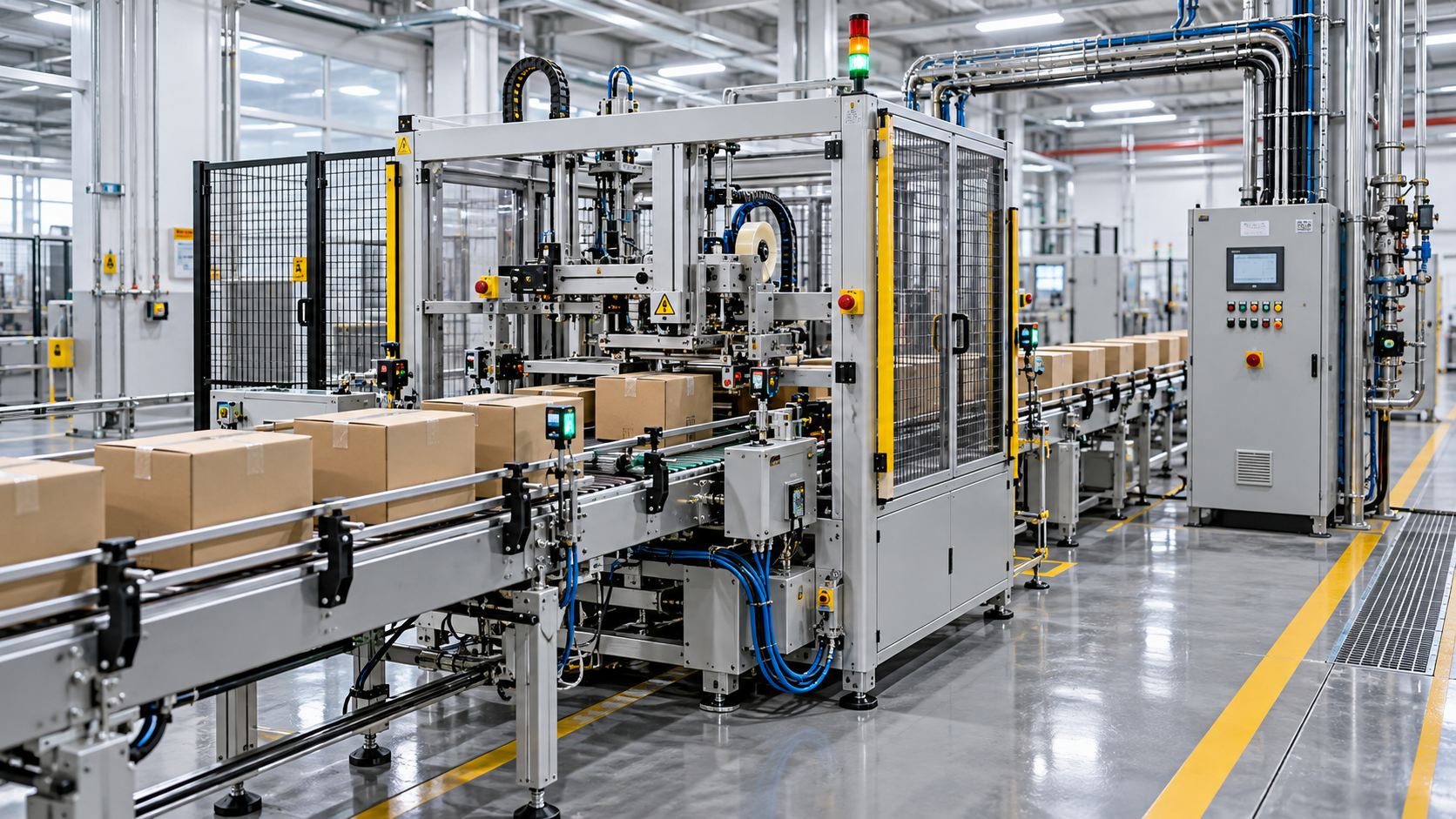
The equipment quote is not the full cost of packaging automation. The amount that matters is the cost of putting a working system into production, sustaining its performance, and managing the transition from the existing process. Installation, integration, tooling, training, and production disruption can change both the funding requirement and the investment’s payback.
There is no defensible universal percentage to add to a machine price. A standalone folder gluer installed in a prepared production area has a different cost profile from a robotic packing cell connected to existing conveyors, inspection systems, and production software. A reliable budget starts with a defined operating requirement and a clear boundary between what the supplier includes and what the buyer must provide.
Define what “installed and operational” actually includes
Two quotations can describe similar equipment while covering substantially different projects. One may include conveyors, guarding, commissioning, and production trials; another may stop at delivery of the main machine. Comparing their headline prices rewards the narrower scope rather than the better commercial offer.
The starting document should specify package formats, material characteristics, required good-output rate, shift pattern, changeover frequency, and upstream and downstream interfaces. For paper-based packaging, board caliper, flute profile, blank dimensions, coating, and adhesive compatibility can affect feeding, folding, and bonding performance. A nominal speed without these conditions is an incomplete purchasing specification.
Separate expenditure into three groups: costs to reach acceptance, recurring operating costs, and disruption or risk allowances. Keep a named owner against each item. “By customer” is not a cost estimate, and “turnkey” is not sufficient evidence that every necessary interface has been included.
Where spending appears beyond the machine
For imported equipment, distinguish permanent costs from cash-flow requirements. Recoverable import taxes may create a funding need without becoming a final economic cost. Currency exposure also matters when deposits, shipment payments, and acceptance payments occur at different times. Financial comparisons should use consistent exchange-rate and tax assumptions.
Site preparation can extend beyond connecting utilities
A machine may fit its allocated footprint but still require access for electrical cabinets, maintenance, material replenishment, and removal of finished packs. Restricted access can force a layout change or create recurring handling labor that was absent from the original savings calculation.
Check utility demand under operating conditions, not just connection availability. Compressed-air pressure and flow at the machine, electrical supply requirements, and extraction needs must be established before installation. Where local safety requirements call for additional guarding or assessment of the assembled line, assign that work explicitly rather than assuming the machine supplier covers it.
Integration costs depend on how the line behaves as a system
Matching conveyor heights is only part of integration. Machines must exchange run, stop, fault, and product-flow signals. Reject handling, accumulation, emergency-stop coordination, and restart sequences also need engineering. A fast packing machine may spend substantial time waiting for product or blocked by downstream equipment if these interfaces are poorly designed.
For a folder-gluing installation, the constraint may move to blank feeding or finished-bundle handling. In an end-of-line cell, case presentation or pallet exchange may limit output. Paying for higher machine speed does not resolve these constraints unless the surrounding scope addresses them.
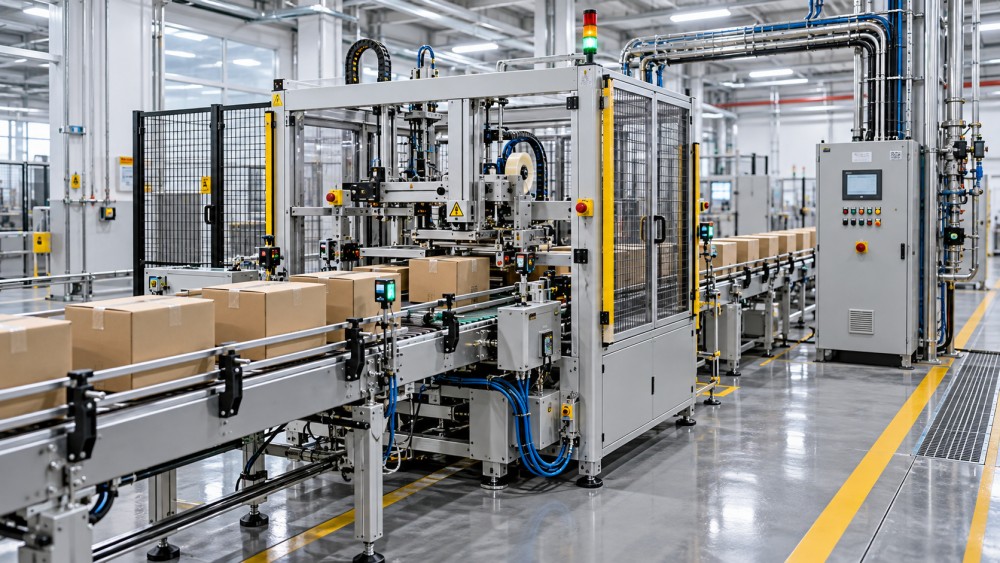
Budget for the product mix, not just the demonstration format
A successful demonstration on one package does not establish the cost of running the full range. Different formats can require guides, change parts, grippers, tooling, adhesive settings, or additional recipes. Include the formats needed at launch and identify the cost and lead time of adding others.
Changeovers also belong in the economic model. A line with many short orders can lose more productive time to setup, cleaning, and first-piece approval than a line running long batches. Ask whether the quoted changeover time includes mechanical adjustment only or also material loading, adhesive stabilization, inspection, and release of acceptable production.
Material assumptions deserve similar scrutiny. Automation may require tighter control of blank dimensions, warp, moisture, or surface friction. If the proposed solution depends on a different board specification or adhesive, calculate that recurring cost against the expected throughput and quality benefits. Do not treat all packaging-material savings as automatic consequences of buying equipment.
Commissioning and ramp-up are separate financial events
Mechanical installation ends when equipment is assembled and connected. Commercially useful operation begins when it produces acceptable packs at the required rate with the intended staffing. The interval between those points needs its own budget.
Costs can include supplier engineers’ travel and accommodation, overtime for internal maintenance teams, trial materials, rejected packs, and temporary manual packing. Training must cover more than starting the machine: fault recovery, changeovers, quality checks, safe intervention, and routine maintenance determine how much external support remains necessary.
Production interruption should be valued using the actual business consequence. If inventory built before installation protects deliveries, the cost may be extra storage, overtime, and working capital. If orders cannot be recovered, lost contribution margin may be relevant. Counting both the same lost margin and the full cost of replacement production would overstate the impact.
A contingency allowance should cover identifiable uncertainty, not conceal missing scope. Unconfirmed foundation requirements, unresolved controls interfaces, and an untested material range are reasons to obtain better information before commitment.
A worked budget: how a $250,000 quote becomes a different investment
The following figures are hypothetical planning assumptions, not market prices or standard industry markups. They show how to structure the calculation; actual quotations must replace every allowance.
In this illustration, funding exceeds the machine price by $150,000, or 60%. That percentage is a result of the assumed scope, not a multiplier to apply to other projects. A prepared site with a self-contained machine could look very different.
Suppose annual incremental operating costs are $35,000, covering maintenance, energy, consumables, software, and support. Over five years, undiscounted expenditure would be $575,000 before residual value, financing, taxes, and any further capital work. This assumes no replenishment expenditure is counted twice between initial spares and annual maintenance.
Recurring costs can change which quotation is cheaper
Maintenance comparisons should identify service intervals, required skills, replacement components, and access to diagnostic tools. A lower purchase price can be offset by expensive proprietary parts or service arrangements, but that conclusion requires a priced maintenance schedule rather than an assumption about supplier origin or brand.
Request operating consumption at representative production conditions. Installed motor power is not the same as electricity consumed, and compressed air has a plant-level energy cost. Adhesives, cleaning products, belts, blades, printheads where fitted, and other wear items need an expected usage basis linked to materials and production volume.
Software terms can also create recurring commitments. Establish which functions work without subscriptions, whether remote diagnostics require a paid service, who controls backups and recipes, and whether replacement controllers need new licenses. For imported machinery, check the cost and practical availability of local support alongside remote response promises.
Test payback against realizable savings
Using the hypothetical $400,000 investment, assume annual labor savings of $110,000, scrap savings of $15,000, and additional contribution margin of $30,000 from saleable output. After subtracting $35,000 in incremental operating costs, annual net benefit is $120,000. Simple payback is approximately 3.3 years.
Those inputs require evidence. Labor savings must reflect positions, overtime, or agency expenditure that can actually be removed—not every manual task the equipment performs. Remaining requirements may include replenishment, inspection, changeovers, and fault recovery. Redeploying employees can create value, but it is not automatically a cash saving.
Extra capacity has financial value only when demand and the rest of the production system can use it. Value additional sales at contribution margin, not revenue. If the same output increase is already embedded in a labor-productivity calculation, check for double counting.
The downside case can reverse the decision. If realizable labor savings fall to $70,000 and no additional sales materialize, while scrap savings remain $15,000 and operating costs remain $35,000, annual net benefit falls to $50,000. Simple payback becomes eight years. For longer investment horizons, discounted cash-flow analysis should supplement payback.
Use acceptance terms to make the budget enforceable
The strongest cost estimate can still unravel if acceptance is based on an easy demonstration rather than the purchased production requirement. Define factory and site acceptance around agreed materials, representative formats, staffing, test duration, good-output rate, reject limits, and changeover conditions. Record how stoppages and upstream or downstream interruptions will be treated.
Payment milestones should distinguish shipment, mechanical completion, and demonstrated performance. The contract should allocate corrective work, repeat testing, service travel, and responsibility for interfaces supplied by others. Warranty commencement also needs attention if delivery substantially precedes usable production.
A sound packaging automation cost comparison therefore ends with three reconciled figures: the cash required to reach accepted operation, the recurring cost of running the system, and the net benefit supported by realistic production assumptions. The better-value offer is the one that delivers the required output with manageable lifecycle cost and clearly allocated risk—not necessarily the one with the lowest equipment price.
Industry Briefing
Get the top 5 industry headlines delivered to your inbox every morning.
Recommended News