
Paper Manufacturing Intelligence for Smarter Line Control
Paper Manufacturing Intelligence for Smarter Line Control
Paper manufacturing intelligence is changing how modern lines are monitored, tuned, and judged. For digital printers, corrugators, die-cutters, folder-gluers, and tissue systems, the real question is no longer speed alone. It is whether the line stays stable when substrate quality shifts, demand changes, and energy targets tighten. That is where paper manufacturing intelligence becomes a practical decision tool.
Why line control now depends on intelligence
In paper-based production, small process errors spread fast. A slight tension drift can affect print registration. A weak glue curve can lower box strength. A poor rewinding profile can create waste before operators even notice. Paper manufacturing intelligence helps connect these signals early.
The shift is visible across the industry. High-speed digital printers need tighter droplet control. Corrugators need better steam balance and flute consistency. Post-press systems need more reliable crease depth, cut accuracy, and stacking output. In each case, paper manufacturing intelligence turns raw machine data into control logic that teams can act on.
What technical evaluators should look for
A strong evaluation starts with process visibility. If a line only shows final output, it is hard to trace the source of defects. Paper manufacturing intelligence should expose tension, moisture, temperature, viscosity, speed, and pressure in one flow. That makes comparison across machines much easier.
- Real-time sensors for web tension and alignment
- Closed-loop control for print, glue, and rewinding stability
- Alarm logic that separates noise from real process drift
- Production records that link scrap to a specific cause
These points matter because technical evaluators are not just checking capability. They are checking repeatability, uptime, and the cost of variation. A machine that looks fast in a demo may still fail under mixed paper grades or long shifts. Paper manufacturing intelligence helps reveal that gap.
Digital printers: where control quality starts
Industrial digital printers depend on precise data handling and stable substrate behavior. Inkjet quality changes quickly when the board surface absorbs unevenly or when web tension shifts. Paper manufacturing intelligence makes those interactions measurable instead of guesswork.
For technical review, watch for droplet placement accuracy, color consistency, and response time after substrate changes. Systems with better intelligence can adapt faster to coated paper, corrugated board, and short-run customization. That is especially useful in e-commerce packaging, where version changeovers are frequent.
A practical sign of maturity is whether the printer can keep registration stable during acceleration and deceleration. If not, production gains can disappear into rework. Paper manufacturing intelligence should support predictive adjustment, not only after-the-fact correction.
Corrugators: tension, steam, and flute quality
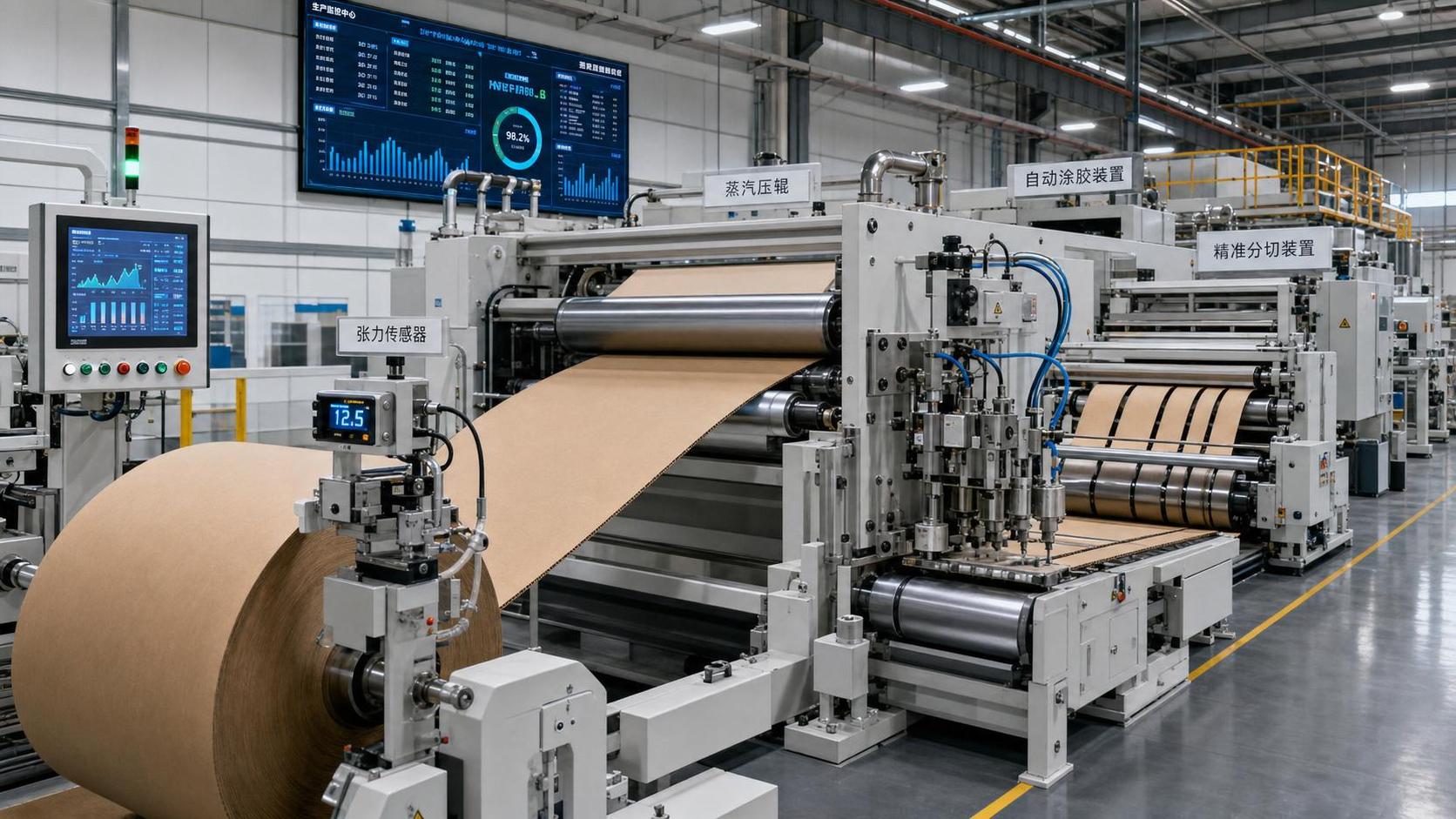
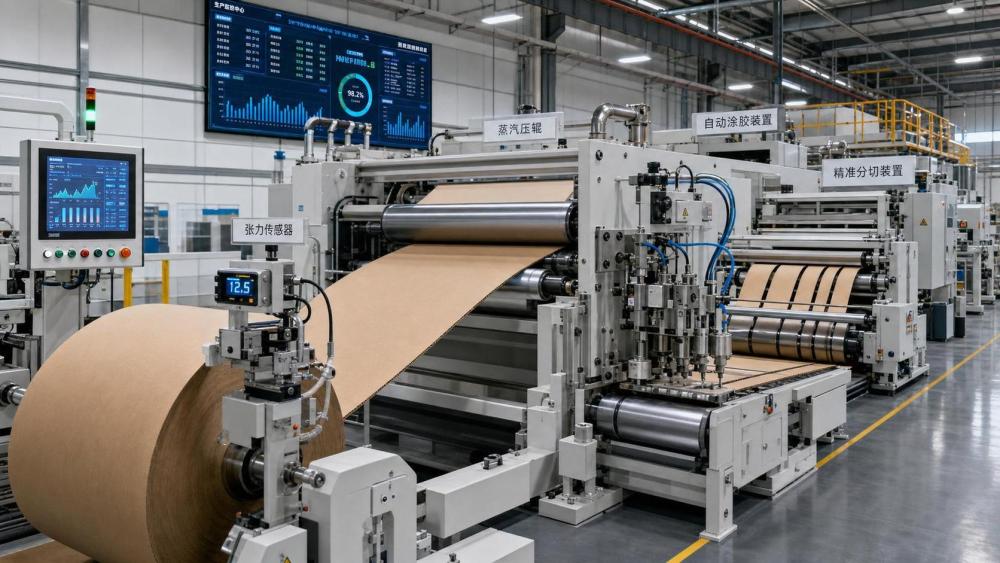
Corrugated board lines are where paper manufacturing intelligence becomes highly visible. These lines run long, fast, and hot. They also combine steam, adhesive, pressure, and tension in a way that magnifies small errors. One unstable zone can affect the full sheet.
The most useful systems track flute formation, moisture balance, liner bonding, and line speed together. That allows operators to see whether a quality issue comes from heat input, paper grade variation, or mechanical drift. In many plants, this is the difference between controlled production and constant firefighting.
Post-press systems and the cost of variation
Die-cutting, stamping, and folder-gluer systems benefit from paper manufacturing intelligence in a different way. Here, the challenge is not only mechanical precision. It is consistency at volume. A machine may cut cleanly at low load and then lose accuracy when speed rises.
This is why evaluators should ask how the system handles folding angle, glue timing, and stroke synchronization. Smart control can reduce misfeeds, crushed edges, and weak bonds. It can also improve changeover speed, which matters when packaging runs are shorter and more customized.
For folder-gluers, paper manufacturing intelligence is especially valuable when comparing cold glue, hot glue, and hybrid bonding methods. The best line is not always the fastest. It is the one that keeps seal quality stable without driving up waste or manual correction.
Tissue machinery and uptime discipline
Tissue processing machinery has its own version of line control. Rewinding, embossing, cutting, and packaging all depend on stable tension and clean synchronization. Because the products are high-volume and low-margin, even small inefficiencies can compound quickly.
Paper manufacturing intelligence supports these lines by reducing roll defects, improving splice handling, and protecting output uniformity. It also helps operators avoid overcorrection. In practice, that means fewer stops, fewer roll losses, and better energy use across the shift.
The most useful benchmark is whether the system keeps performance steady after long runs. A line that only works well at startup is not enough. Technical evaluators should look for sustained control under real plant conditions, not just clean lab data.
How to evaluate sustainability without losing performance
Sustainability is now part of equipment selection, not a side note. FSC, EUDR, recyclable substrates, and paper replacing plastic programs all influence purchasing decisions. Paper manufacturing intelligence helps connect these goals to actual line behavior.
A good system should reduce scrap, support lower energy consumption, and keep output reliable across recycled or lightweight materials. That matters because greener materials often behave differently on the line. Without smart control, sustainability can raise costs instead of lowering them.
The clearest sign of readiness is whether the line can document its process settings and quality outcomes. That documentation helps with audits, buyer reviews, and international tenders. It also gives manufacturers a stronger story when they need to prove both efficiency and environmental credibility.
Practical selection checklist
Before final approval, it helps to compare systems using the same operational lens. Paper manufacturing intelligence should be judged by what it improves in daily use, not by the number of features on a brochure.
- Can the line detect drift before defects build up?
- Does control remain stable during grade and speed changes?
- Are waste, downtime, and rework clearly traceable?
- Can sustainability targets be met without sacrificing yield?
When those answers are clear, the buying decision becomes much easier. The right platform improves throughput, protects quality, and supports future automation. More importantly, it gives teams a way to control risk instead of reacting to it.
Conclusion
Paper manufacturing intelligence is no longer a nice-to-have layer. It is becoming the core of smarter line control across printing, corrugation, post-press, and tissue production. For technical evaluators, the priority is simple: choose systems that make variation visible, control actions faster, and output more predictable.
If you are comparing equipment now, focus on how well each line turns data into stable production. That is where efficiency, sustainability, and long-term competitiveness start to align.
Industry Briefing
Get the top 5 industry headlines delivered to your inbox every morning.
Recommended News