
EU EUDR Traceability System Enforces June 1, 2026
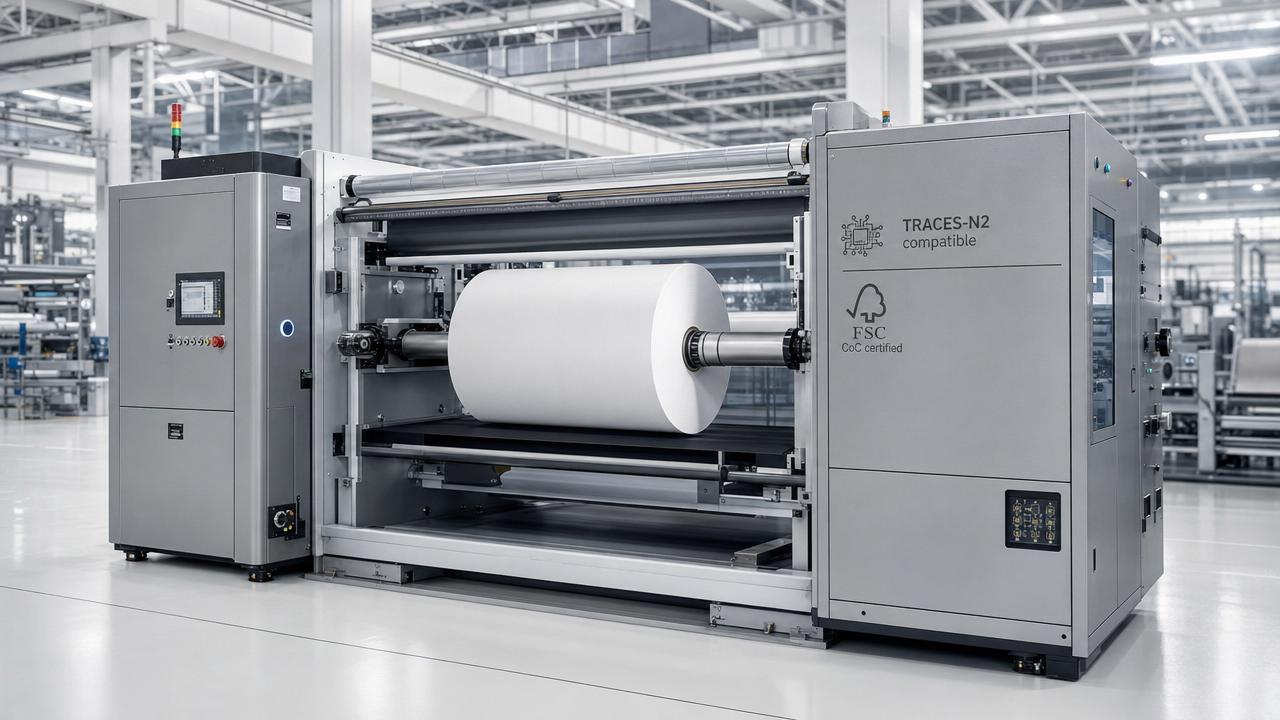
Starting June 1, 2026, the EU’s Regulation on Deforestation-free Products (EUDR) mandates traceability compliance for tissue rewinding equipment exported to the EU — impacting manufacturers, exporters, and supply chain stakeholders in the hygiene paper machinery sector.
Event Overview
Per the EU’s Implementing Regulation for the Regulation on Deforestation-free Products (EUDR), as of June 1, 2026, all tissue rewinders exported to the European Union must integrate with the EU’s TRACES-N2 platform. This integration must enable automatic transmission of three data points: FSC Chain-of-Custody (COC) certificate number, geocoordinates of the timber harvest site, and transport batch number. As of the latest public update, seven Chinese equipment manufacturers have passed pre-audit certification by TÜV Rheinland.
Industries Affected by This Requirement
Equipment Manufacturers (Tissue Rewinder OEMs): Directly affected, as their control systems must be technically adapted to interface with TRACES-N2 and support real-time data export. Non-compliant units may face customs rejection or market access suspension in the EU.
Exporters & Trading Companies: Face increased documentation and verification responsibilities; shipment-level traceability becomes a contractual and regulatory prerequisite.
End-User Converters (Hygiene Paper Producers): May need to coordinate with equipment suppliers to ensure installed or newly procured rewinding lines meet EUDR-ready specifications — especially when sourcing from non-EU suppliers.
Supply Chain Certification Providers & Integrators: Demand is rising for FSC COC system audits, API development support, and TRACES-N2 connectivity validation services tailored to industrial machinery control systems.
What Relevant Enterprises or Practitioners Should Focus On — And How to Respond Now
Monitor official guidance updates from the European Commission and national competent authorities
The TRACES-N2 technical interface specifications for industrial machinery remain under refinement. Enterprises should track published technical notes, sandbox testing windows, and deadlines for mandatory registration — not just the June 1, 2026 enforcement date.
Prioritize verification of FSC COC coverage across upstream raw material sourcing
EUDR compliance hinges on verifiable forest origin data. Equipment suppliers must confirm that their customers’ paper suppliers hold active, jurisdictionally valid FSC COC certificates — and that those certificates explicitly cover the relevant production batches and geographic sources.
Distinguish between policy signal and operational readiness
Passing a TÜV Rheinland pre-audit does not equate to full TRACES-N2 go-live readiness. Enterprises should verify whether certified vendors have completed end-to-end data flow testing with live TRACES-N2 endpoints — including error handling, batch reconciliation, and audit log generation.
Initiate internal cross-functional alignment on data governance and system integration
Compliance requires coordination among engineering, IT, quality assurance, and export compliance teams. Early mapping of existing control system architectures (e.g., PLC/SCADA platforms, MES interfaces) against TRACES-N2 API requirements helps identify integration scope, timeline, and third-party dependencies.
Editorial Perspective / Industry Observation
Observably, this requirement marks a structural shift: machinery is no longer treated solely as capital equipment, but as a traceability node within commodity supply chains. Analysis shows that EUDR’s extension to manufacturing equipment reflects the EU’s broader strategy of upstream accountability — targeting not only raw materials but also the tools enabling their processing. From an industry perspective, this is less a one-off deadline and more a signal of increasing regulatory convergence across environmental due diligence frameworks. Current enforcement focuses on tissue rewinders, but similar requirements could extend to other pulp-and-paper machinery categories where origin-linked production steps are involved. Continuous monitoring is warranted — not just for updates to EUDR, but for parallel developments in UK, US, and Japanese sustainability import rules.
Conclusion: The June 1, 2026 EUDR traceability mandate for tissue rewinders represents a concrete step in regulatory tightening around deforestation-linked value chains. It is neither a speculative risk nor a fully matured operational norm — rather, it is an active transition point requiring targeted technical and procedural adaptation. Enterprises are better served treating this as a defined systems integration project with clear data lineage requirements, rather than a generalized compliance checklist.
Source(s): Official EU Implementing Regulation for EUDR (Regulation (EU) 2023/1115); Public announcements by TÜV Rheinland regarding pre-audit outcomes; EU Commission TRACES-N2 technical documentation (v.2025.2).
Note: Ongoing implementation details — including TRACES-N2 API versioning, fallback procedures for connectivity failure, and enforcement protocols at EU border control posts — remain subject to further official publication and require continuous observation.
Industry Briefing
Get the top 5 industry headlines delivered to your inbox every morning.
Recommended News