
Tissue Processing Machines Price: Cost Drivers and Budget Benchmarks in 2026
Why does tissue processing machines price vary so much in 2026?
Tissue processing machines price has become a sharper budgeting issue in 2026.
Capacity targets are rising, while energy, labor, and compliance costs remain difficult to predict.
That is why two lines producing similar tissue rolls can still land in very different price bands.
In practical terms, buyers are no longer comparing machine tags alone.
They are comparing uptime, automation depth, packaging integration, and how quickly the line reaches stable output.
This is especially relevant across the broader print and paper equipment landscape.
IPPS tracks similar cost logic across digital printers, corrugated board lines, folder gluers, and tissue systems.
The common pattern is clear.
Higher precision, tighter tension control, faster changeovers, and lower labor dependency usually push capital cost upward.
The harder question is whether that premium pays back fast enough.
For most sourcing decisions, tissue processing machines price should be read as a bundle of hardware, controls, risk, and future operating expense.
What usually sits behind the price tag?
The biggest driver is line configuration.
A stand-alone rewinder costs far less than a full converting and packaging line.
Once embossing, lamination, log saws, bundling, and case packing are added, tissue processing machines price rises quickly.
Speed also matters, but not in a simple linear way.
Moving from mid-speed production to high-speed output usually requires stronger mechanics and better servo coordination.
That is where price jumps become more visible.
Embossing technology is another decisive factor.
Basic embossing heads cost less, while steel-to-steel, nested, or decorative patterns can add tooling and setup complexity.
When product differentiation matters, this premium may be justified.
Automation depth often separates low quote from realistic quote.
Automatic core feeding, tail sealing, roll transfer, reject handling, and recipe management reduce labor pressure.
They also reduce start-up instability and material waste.
Energy design is becoming more visible in supplier discussions.
Efficient drives, vacuum systems, and tension algorithms may increase upfront cost, yet lower lifecycle burden.
IPPS has observed the same trend in broader paper-based manufacturing.
Control sophistication increasingly defines competitiveness, not just raw machine width or speed.
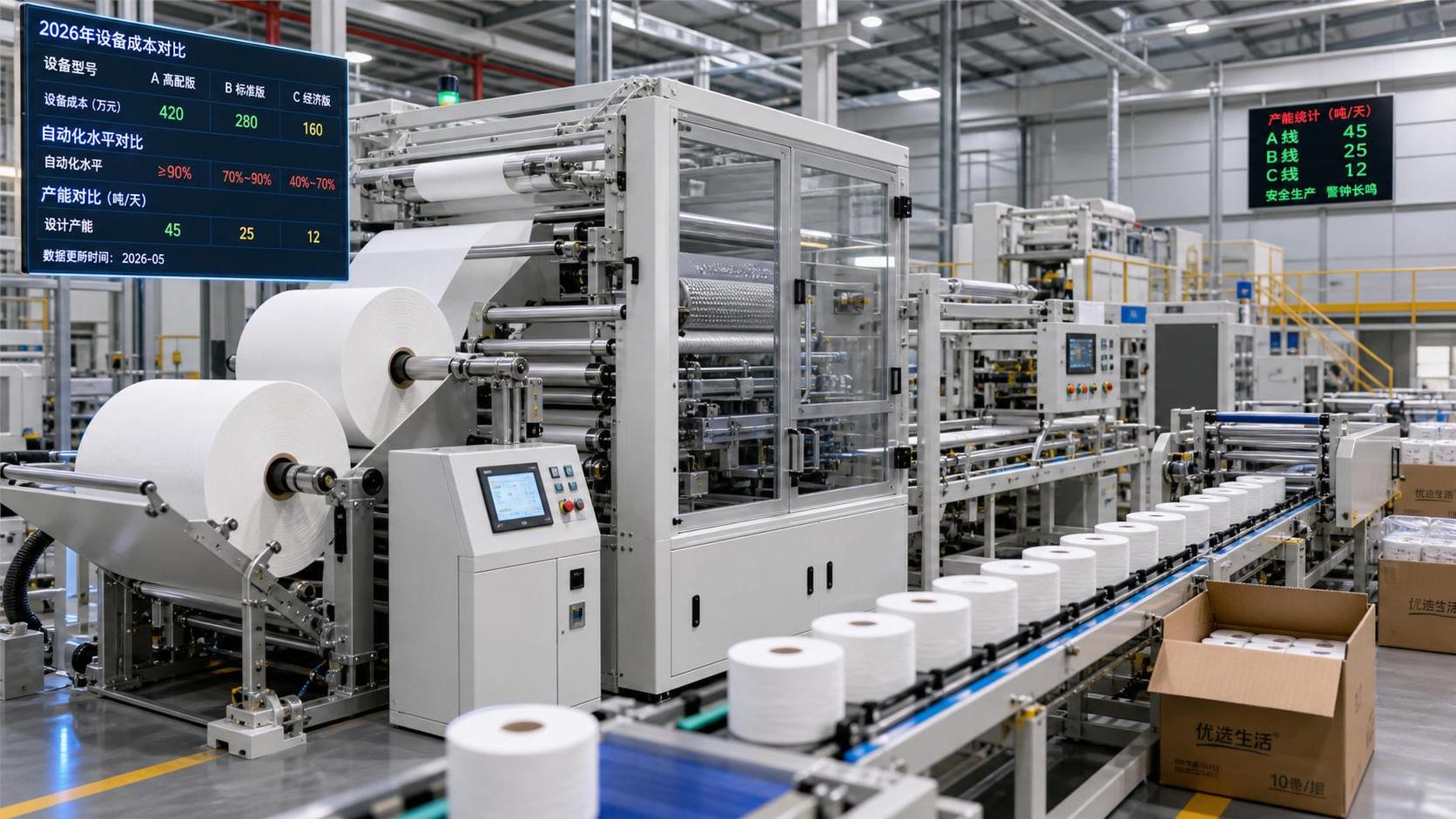
A quick benchmark table for 2026 budgeting
The ranges below are broad planning references.
Actual tissue processing machines price depends on country of origin, scope, and customization.
These figures help frame discussion, but they should never replace a detailed scope matrix.
How do you tell whether a quoted price is fair or incomplete?
A low number can look attractive until the missing items appear later.
The better approach is to break tissue processing machines price into visible and hidden layers.
Visible layers include the machine body, standard tooling, drives, PLC, and operator stations.
Hidden layers often include installation, commissioning, training, spare kits, freight, and local compliance work.
A fair quote also defines performance clearly.
Ask whether the advertised speed is mechanical speed, stable production speed, or speed with packaging synchronized.
That single clarification can change the economic picture.
It also helps to compare waste assumptions.
A faster line with poor web handling may consume more parent roll material than a slower but more stable setup.
In actual sourcing reviews, these checkpoints usually reveal whether the quote is grounded.
- State the finished product mix by diameter, ply, embossing, and pack format.
- Separate guaranteed output from theoretical maximum speed.
- Confirm whether packaging machines are included or only interfaced.
- List utility requirements, especially power, air, vacuum, and floor space.
- Request wear parts pricing for the first 12 to 24 months.
Without this structure, comparing tissue processing machines price across suppliers becomes unreliable.
Which options raise cost but often make sense anyway?
Not every premium feature is cosmetic.
Some options directly protect throughput, hygiene consistency, and long-term operating discipline.
Automatic packaging integration is one of the most common examples.
It raises tissue processing machines price, but it can reduce labor exposure and downstream congestion.
Advanced tension control is another worthwhile upgrade.
IPPS regularly highlights tension decoupling as a key performance lever across paper systems.
In tissue converting, this means cleaner rewinding, fewer breaks, and more stable embossing quality.
Recipe storage and remote diagnostics also deserve attention.
They do not always impress in a showroom, yet they shorten changeovers and simplify troubleshooting.
That matters when product runs are shorter and SKU variety keeps growing.
The more useful question is not whether these features cost more.
It is whether they reduce enough downtime, waste, or manual handling to justify the spend.
A simple decision table
What mistakes cause tissue processing machines price decisions to go wrong?
The first mistake is buying on output headline alone.
A line that runs fast only under ideal conditions may disappoint in normal production.
The second mistake is underestimating product mix complexity.
Toilet tissue, kitchen towel, folded towel, and facial tissue need different handling logic.
Trying to make one low-cost line do everything often leads to poor efficiency.
Another common issue is ignoring installation reality.
Floor loading, ceiling clearance, dust control, and utility stability can all reshape the final budget.
There is also a documentation risk.
If acceptance criteria, spare support, and training depth are vague, the cheapest tissue processing machines price can become the most expensive project.
In a market shaped by sustainability pressure and paper-based manufacturing upgrades, buyers should also check energy and compliance readiness.
That wider context matters more in 2026 than it did a few years ago.
So what is a practical way to budget and shortlist in 2026?
Start with the finished product plan, not the machine brochure.
Define roll sizes, ply structure, embossing style, pack type, and required annual output.
Then split the budget into three layers.
One layer covers equipment.
One covers installation and start-up.
One covers the first year of wear parts, training, and stabilization losses.
For shortlist work, request quotations in the same format.
That makes tissue processing machines price easier to compare on equal terms.
It also helps to screen suppliers through broader paper-equipment intelligence.
IPPS follows the operational logic behind automation, tension control, energy performance, and lifecycle yield across the paper value chain.
That perspective is useful because tissue projects rarely succeed through hardware choice alone.
They succeed when price, line architecture, service scope, and operating discipline match the real production model.
A sensible next step is to build a comparison sheet with fixed technical assumptions, target output, utility limits, and acceptance standards.
That turns tissue processing machines price from a confusing quote exercise into a defensible investment decision.
Industry Briefing
Get the top 5 industry headlines delivered to your inbox every morning.
Recommended News