
EUDR Round 3 Extends Traceability to Tissue Rewinders
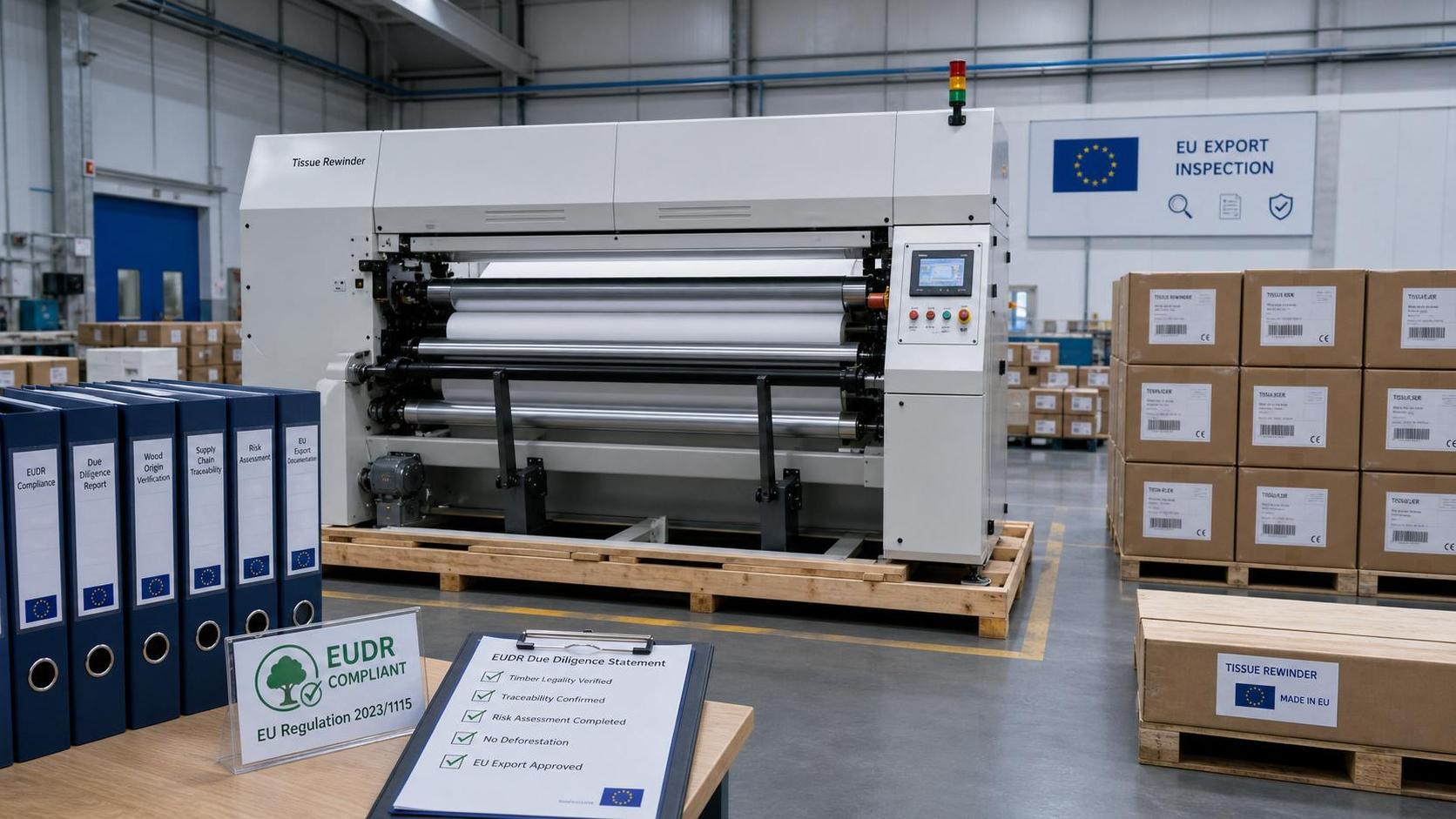
On July 5, 2026, the European Commission opened the third mandatory EUDR certification filing window and, for the first time, brought tissue converting equipment, including Tissue Rewinders, into the scope of supply chain due diligence. For importers, equipment manufacturers, sourcing teams, and export businesses serving the EU market, the immediate point of attention is no longer limited to machine performance or delivery schedules: wooden structural parts inside the equipment must now be supported by certification and origin traceability documents, with direct implications for customs timing and compliance cost.
What the new filing window now covers
The confirmed change is that the third EUDR mandatory certification round formally started on July 5, 2026. According to the provided information, this round newly includes tissue processing equipment, including Tissue Rewinders, within the due diligence scope.
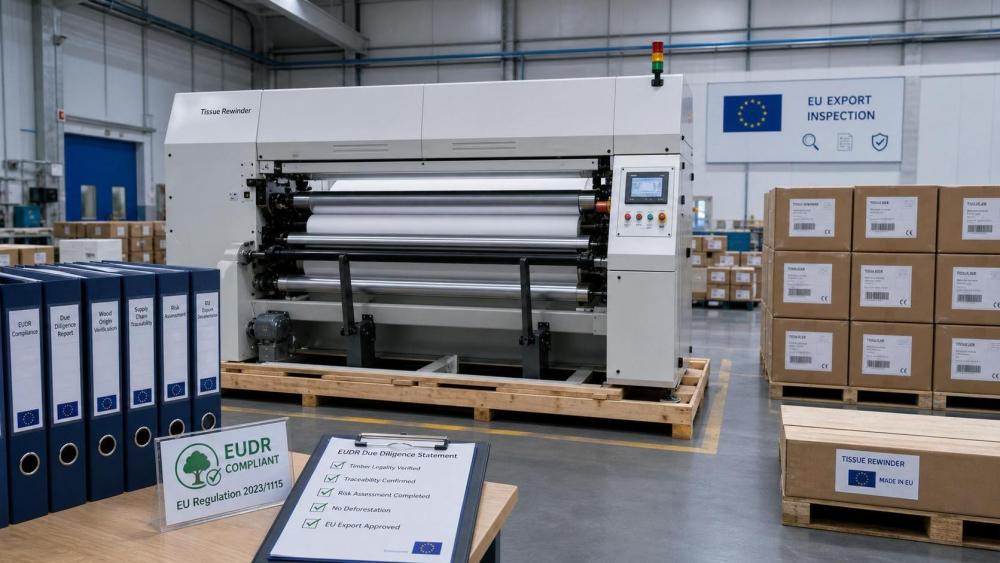
The requirement described in the event summary is specific to wooden structural parts used in the equipment. Importers must demonstrate that all such components, including examples such as guide roll brackets and paper rack bases, meet both FSC and PEFC certification requirements and can be traced back to timber origins at the geographic coordinate level.
The information also makes clear that this requirement has a direct effect on the customs clearance timing and compliance cost of Tissue Rewinders exported from China to the EU.
Where the pressure is likely to appear first
Export transactions may face tighter document checks
From an industry perspective, direct trading companies and exporters are likely to feel the impact first because customs and import-side compliance reviews depend on document completeness. The issue is not only whether the machine can be shipped, but whether every wood-related component in the shipped equipment can be matched with acceptable certification and traceability records.
What deserves closer attention is the handoff between sales, documentation, and shipment preparation. If supporting records for wood parts are incomplete or inconsistent, customs timing may be affected.
Equipment manufacturing will need closer control over component sourcing
For processing and equipment manufacturing businesses, the impact is likely to concentrate on procurement and bill-of-material review. The event summary points specifically to wooden structural parts, which means manufacturers supplying the EU market may need to examine whether those components are identifiable, documentable, and aligned with the importer's compliance needs.
Analysis shows that the commercial issue is not only the existence of wood in the machine, but whether the source information for those parts can travel through the full supply chain in a usable form.
Importers and EU-facing buyers will carry a heavier due diligence burden
Importers are explicitly named in the provided information as the party that must prove compliance. This means the burden on EU-facing buyers is likely to rise in document review, supplier communication, and filing preparation. Their concern is likely to extend beyond product specification into supplier transparency and response speed.
Observably, any gap between what an exporter can provide and what an importer must submit may become a practical bottleneck even before goods reach final clearance.
Supply chain service providers may see more coordination work
Service providers involved in customs support, documentation handling, and cross-border delivery may also be affected because the compliance question now touches material origin evidence inside the equipment itself. The operational challenge is likely to center on document consistency, pre-shipment verification, and communication across multiple suppliers.
What companies should watch in practice
Whether later official wording adds detail
What deserves closer attention is whether subsequent official language further clarifies how wooden structural parts in equipment will be defined and reviewed in filing practice. The event summary confirms the new scope and the traceability direction, but businesses will need to keep watching how these requirements are expressed in later compliance communication.
Which product configurations involve wood-based structural parts
Companies shipping Tissue Rewinders to the EU should pay close attention to which machine configurations include wood-based supports, bases, or other structural components. The practical question is whether those parts exist in the delivered configuration and whether they can be documented to the level required by the importer.
Whether supplier records can support dual certification and origin tracing
Analysis shows that FSC/PEFC dual certification alone is not the only issue raised by the event summary. Importers must also prove geographic-coordinate-level timber origin traceability. That makes supplier qualification, supporting records, and document continuity a central issue for procurement and compliance teams.
How compliance affects lead time and customer communication
The provided information explicitly links the new requirement to customs clearance timing and compliance cost for Chinese exports to the EU. In practical terms, companies should watch whether additional document preparation changes delivery planning, contract timing, or customer communication before shipment.
Why this matters beyond a single filing cycle
Observably, this development signals that compliance review is reaching deeper into the material composition of industrial equipment, not only the finished machine as a traded item. For the tissue machinery segment, that is a meaningful shift in what import-side due diligence may require from exporters and manufacturers.
It is more appropriate to understand this as both an immediate operational change and a longer-term compliance signal. The immediate part is clear from the filing window opening and the stated documentation burden. The longer-term part still requires observation, especially in how consistently the rule is applied in actual trade workflows.
How the market is likely to read this development
At this stage, the most balanced reading is that the event creates a concrete compliance task rather than a settled market outcome. The confirmed facts already point to higher documentation expectations for Tissue Rewinders entering the EU, particularly where wood-based structural parts are involved.
From an editorial perspective, this should be read neither as a routine paperwork update nor as a basis for broad conclusions about market direction. It is a specific regulatory signal with immediate implications for customs timing, sourcing transparency, and importer-exporter coordination, and it remains a development that warrants continued monitoring.
Basis of this report and what still needs verification
This article is based on the user-provided news title, event date, and event summary concerning the July 5, 2026 launch of the third EUDR mandatory certification filing window and its application to Tissue Rewinders.
For this type of industry update, source verification would typically involve official notices, company statements, industry association updates, authoritative media reporting, and relevant standards or certification documentation. No specific official source link was provided in the input, so continued verification is still necessary.
Follow-up attention should focus on whether additional official explanations, filing interpretations, or implementation details further define document standards for wooden structural parts and importer due diligence practice.
Industry Briefing
Get the top 5 industry headlines delivered to your inbox every morning.
Recommended News