
Precision Die Cutting Tolerances That Affect Yield

In high-speed converting, precision die cutting is not only about visual edge quality. It determines whether blanks register correctly, fold consistently, glue accurately, and survive packing, transport, and filling with minimal scrap. When tolerances drift, yield falls long before obvious defects appear. A small shift in cut, crease, or board behavior can multiply losses across printing, stripping, folding, and case erection.
For industrial print, corrugated converting, and post-press operations, tolerance control offers a practical way to judge real process capability. It reveals the relationship between tooling condition, press stability, substrate variation, and machine setup discipline. This guide breaks down the die cutting tolerances that most affect yield and shows how to evaluate them in a structured way.
Why a Checklist Matters in Precision Die Cutting
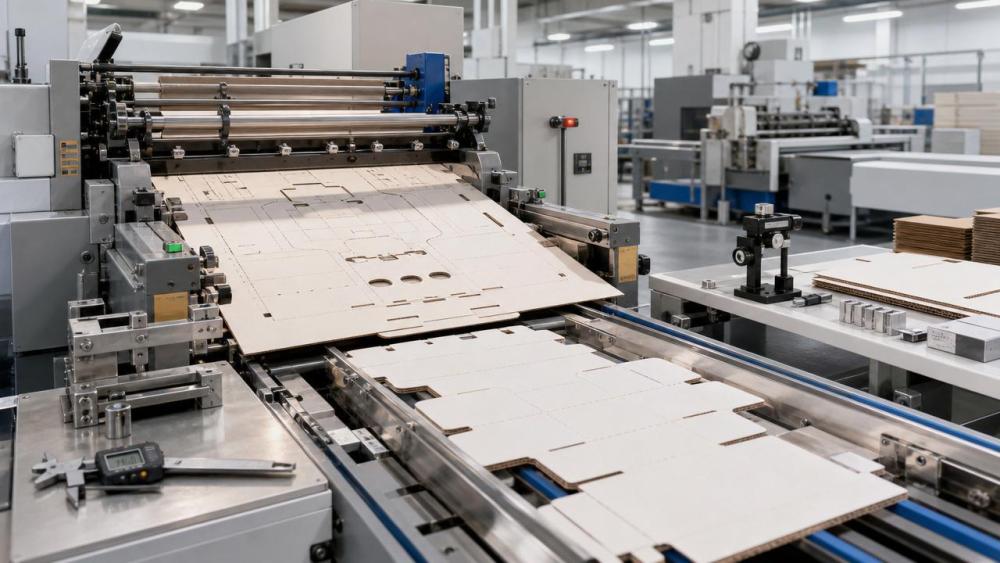
Yield losses rarely come from one dramatic failure. More often, they come from stacked micro-errors. A sheet can remain technically “within spec” at the die cutter, yet still create waste at folding, gluing, sealing, or automatic filling.
A checklist approach helps isolate what really drives converting performance. It prevents over-focusing on one dimension while missing pressure balance, board springback, nick strength, or register drift under speed.
For any operation using precision die cutting, the goal is not the tightest theoretical tolerance. The goal is stable, repeatable tolerance that supports throughput, carton functionality, and downstream compatibility.
Core Checklist: Tolerances That Directly Affect Yield
- Verify cut-to-print registration under production speed, not only during make-ready, because dynamic sheet movement often widens error bands once feeder load and press vibration increase.
- Measure blank overall dimensions at multiple sheet positions, since side-to-side and lead-to-tail variation often exposes uneven pressure, board caliper spread, or chase alignment issues.
- Check crease width and crease depth together, because accurate lines alone do not guarantee folding quality if compression damages liners or leaves unstable hinge behavior.
- Control internal feature tolerances, including slots, windows, tabs, and lock shapes, because minor mismatch in these areas can stop automated erection or reduce pack integrity.
- Inspect knife penetration consistency across the sheet, since incomplete cuts create stripping problems while overcutting accelerates anvil wear and weakens edge quality.
- Evaluate nick size and nick placement carefully, because poor nick strategy can cause premature breakout, hanging waste, blank edge tears, or unstable delivery stacking.
- Track sheet-to-sheet repeatability over time, not just average dimensions, because good mean results can hide unstable process spread that lowers real production yield.
- Compare tolerance performance across substrate lots, as moisture, flute profile, fiber direction, coating, and recycled content can shift precision die cutting behavior significantly.
- Confirm stripping and blanking tolerance capability, because clean die cutting means little if waste removal creates edge fractures, panel deformation, or hidden dimensional drift.
- Document machine speed versus tolerance stability, since maximum rated speed may be unusable when registration, creasing accuracy, or waste removal begin to deteriorate.
How to Read the Checklist Correctly
These points work best as a linked system. For example, a crease problem may seem like tooling wear, but the actual root cause may be board moisture or uneven impression across the platen.
In precision die cutting, dimensional tolerance must be judged together with functional tolerance. A carton that measures correctly but cracks on folding still reduces yield.
Key Tolerance Categories Explained
1. Registration Tolerance
Registration defines the relationship between printed graphics and die-cut geometry. In retail packaging, even a small shift can expose white edges, misalign varnish, or disrupt barcode readability.
In corrugated work, registration also affects score position relative to flute structure. Poor alignment can reduce fold precision and create panel asymmetry during box conversion.
2. Blank Dimension Tolerance
Overall length and width influence every downstream step. If the blank grows or shrinks outside process capability, folding rails, glue lines, and packing nests lose consistency.
Stable blank dimensions are one of the clearest indicators of mature precision die cutting. They reflect machine rigidity, feed control, and tooling maintenance discipline.
3. Crease Geometry Tolerance
Crease performance depends on rule, matrix, substrate thickness, flute type, and liner quality. A crease can look clean yet still fold poorly if the compression profile is wrong.
This matters especially in coated board and digital print applications, where surface brittleness can turn slight over-creasing into cracking and visible cosmetic rejection.
4. Feature and Slot Tolerance
Tabs, locks, hand holes, windows, and vent slots require closer attention than outer profiles. These features often determine whether packaging functions correctly in use.
Because they carry interlocking or ergonomic roles, feature errors can create failure even when the main blank passes routine dimensional checks.
Application Notes Across Different Converting Scenarios
Folding Cartons
In folding cartons, crease quality and registration usually dominate yield. Graphic alignment, panel squareness, and glue flap position must stay stable through high-speed folder gluer transfer.
For short runs with digital print, precision die cutting must also account for substrate-to-substrate variation. Frequent job changes make setup repeatability especially important.
Corrugated Packaging
Corrugated converting adds complexity because flute direction, board warp, moisture, and crush sensitivity interact with die cutting pressure. Tolerance windows may need to reflect structural, not purely cosmetic, priorities.
Slots and scores are often more yield-critical than decorative features. Minor variation can affect case squareness, pallet strength, and automated case forming.
Labels, Inserts, and Specialty Paper Components
Thin materials respond faster to rule sharpness and penetration changes. Here, tolerance control often centers on kiss-cut depth, release behavior, and matrix stripping consistency.
In these applications, the best precision die cutting results usually come from close monitoring of pressure uniformity and material tension stability.
Commonly Overlooked Risks
- Ignoring board conditioning before conversion. Moisture imbalance can change cut resistance, crease behavior, and dimensional stability within the same shift.
- Judging tooling only by age. A newer die can still perform poorly if ejection rubber, matrix pairing, or knife profile selection is mismatched.
- Using average data without spread analysis. Process capability depends on variation band, not one favorable sample set.
- Separating die cutting from downstream feedback. Folder gluer jams and erection failures often trace back to hidden tolerance problems upstream.
- Running at advertised top speed during validation. True yield should be tested at sustained speed with realistic stack height and operator intervention limits.
Practical Execution Recommendations
Start with a tolerance map, not a single pass-fail number. Define which dimensions are visual-critical, fold-critical, lock-critical, and automation-critical.
Sample across the sheet layout and across the run duration. This exposes localized pressure differences and stability loss after heat, wear, or speed changes.
Link die-cut data with stripping, folding, and gluing performance. The most useful precision die cutting evaluation always follows the blank into the next process.
Use repeatable measurement methods. Vision systems, calibrated gauges, crease inspection standards, and board conditioning records improve comparison quality from run to run.
Review tolerance capability whenever substrate mix changes. Recycled liners, lighter grammages, specialty coatings, and digital print layers can all alter performance at the die cutter.
Conclusion and Next-Step Action
The most important die cutting tolerances are the ones that protect usable output, not just inspection reports. Registration, blank dimensions, crease geometry, feature accuracy, and repeatability together define real yield.
A disciplined checklist makes precision die cutting easier to evaluate across equipment, tooling, and substrate conditions. It turns scattered observations into process insight.
As a practical next step, build a tolerance review sheet that connects die-cut measurements with stripping results, folding quality, glue accuracy, and final pack performance. That full-path view is where hidden yield gains usually appear.
Industry Briefing
Get the top 5 industry headlines delivered to your inbox every morning.
Recommended News