
China Tightens VOCs Rules: Dry Lamination Lead Times Extend to 12 Weeks

On May 28, 2026, China’s Ministry of Ecology and Environment issued the Guidance on Enhanced End-of-Pipe VOCs Control for Printing and Packaging Industries, mandating RTO + activated carbon dual-mode purification systems for all newly manufactured or exported dry lamination equipment. This regulatory update directly affects lead times for key packaging machinery exports—and signals a shift in compliance expectations for global supply chains serving Chinese-manufactured equipment.
Event Overview
On May 28, 2026, the Ministry of Ecology and Environment released the Guidance on Enhanced End-of-Pipe VOCs Control for Printing and Packaging Industries. The guidance requires that all new or export-bound dry lamination production lines be equipped with an integrated regenerative thermal oxidizer (RTO) plus activated carbon adsorption system. As a result, equipment integration and factory acceptance testing cycles have extended from six weeks to twelve weeks. In contrast, high-speed corrugators—due to their inherently low-VOC wet-end process—are explicitly exempted from this requirement; their delivery timelines remain unchanged at eight to ten weeks.
Impact on Specific Subsectors
Export-oriented machinery manufacturers
Manufacturers producing dry lamination lines for overseas markets face longer order-to-shipment windows. The added engineering, integration, and validation steps for dual-mode VOCs systems increase both resource allocation and scheduling complexity—particularly for orders targeting EU, North American, or Southeast Asian markets where delivery timing is contractually binding.
Integrated line suppliers (e.g., folder-gluer & litho-laminating glueer providers)
These suppliers often bundle dry lamination units into full-line solutions. Extended dry lamination lead times now constrain overall line assembly schedules. Delays may cascade across dependent subsystems—including feeding, cutting, and stacking modules—even if those components themselves are unaffected by the VOCs rule.
Importers and distributors handling dry lamination equipment
Distributors managing inventory or consignment stock must reassess buffer stock levels and customer communication protocols. A 12-week build cycle reduces flexibility in responding to urgent regional demand spikes or replacement needs—especially where local service support relies on just-in-time parts logistics tied to equipment shipment dates.
What Affected Enterprises Should Monitor and Do Now
Track official implementation clarifications
While the guidance was published on May 28, 2026, its enforcement timeline—including applicability to pending orders, retrofit requirements, and certification procedures—has not yet been detailed. Enterprises should monitor announcements from provincial ecological environment departments and customs authorities for operational thresholds.
Reassess order sequencing for mixed-line projects
For integrators delivering turnkey lines containing both dry lamination and exempted equipment (e.g., high-speed corrugators), it is now more critical to sequence procurement and assembly around the longest lead item. Prioritizing dry lamination unit orders early—even before final line configuration—is advisable to avoid bottlenecks.
Differentiate between policy signal and enforceable obligation
The guidance applies specifically to newly manufactured or exported dry lamination equipment. It does not retroactively apply to existing units nor extend to other dry-process machinery (e.g., coating or metallizing lines) unless separately specified. Enterprises should verify scope boundaries before adjusting internal compliance or procurement policies.
Update customer-facing timelines and contractual terms
Sales and project management teams should revise standard delivery commitments for dry lamination lines—and clarify VOCs-related scope exclusions (e.g., site commissioning support, operator training) in contracts. Proactive communication with buyers about revised lead times helps mitigate disputes and supports realistic deployment planning.
Editorial Observation / Industry Perspective
Observably, this guidance functions less as an immediate operational disruption and more as a structural calibration point: it confirms VOCs control is becoming a non-negotiable technical baseline—not just for domestic air quality compliance, but for export-grade equipment design. Analysis shows the exemption for high-speed corrugators reflects a growing regulatory preference for process-based emission differentiation over blanket technology mandates. From an industry perspective, the 12-week extension is not merely a logistical slowdown—it underscores how environmental policy is now embedded in core mechanical engineering specifications and international trade readiness. Continued attention is warranted as provincial enforcement practices begin to diverge and third-party verification standards emerge.
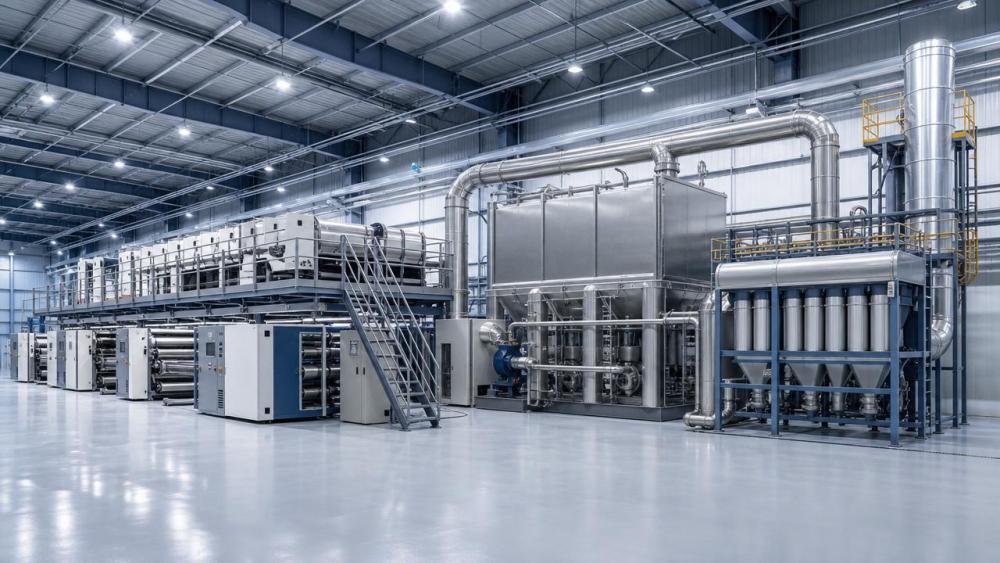
China’s tightening of VOCs requirements for dry lamination equipment marks a concrete step toward aligning export manufacturing standards with domestic environmental targets. While high-speed corrugators remain operationally insulated, the broader implication is clear: VOCs compliance is no longer a peripheral add-on, but a foundational design parameter for certain packaging machinery categories. For stakeholders, this is best understood not as a temporary bottleneck—but as an indicator of evolving technical and regulatory expectations in global packaging equipment supply chains.
Source: Ministry of Ecology and Environment of the People’s Republic of China — Guidance on Enhanced End-of-Pipe VOCs Control for Printing and Packaging Industries, issued May 28, 2026.
Note: Enforcement details—including effective date for orders placed prior to May 28, 2026, and certification pathways for dual-mode systems—remain under observation and are subject to further official clarification.
Industry Briefing
Get the top 5 industry headlines delivered to your inbox every morning.
Recommended News